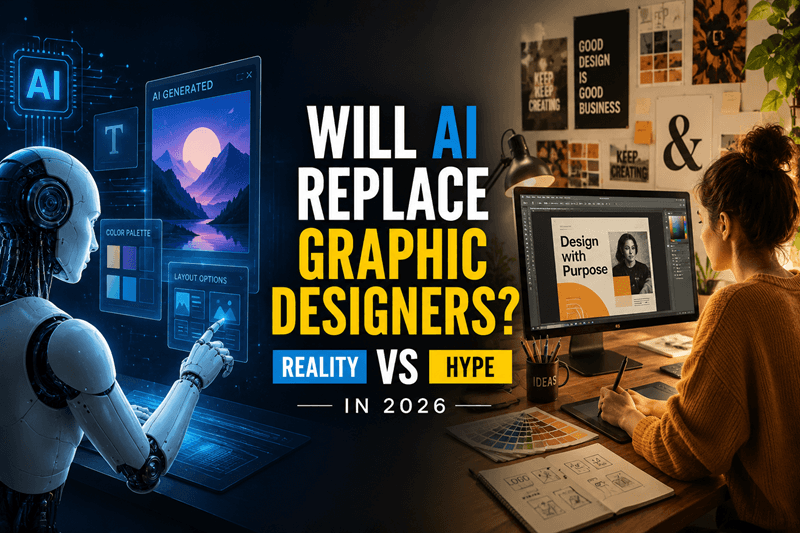
Artificial intelligence is changing almost every industry, and graphic design is no exception. From AI image generators to automated branding tools, businesses can now create logos, social media graphics, and marketing visuals in minutes. This rapid growth has sparked one major question across the creative industry: Will AI replace graphic designers?
The short answer is no. AI is transforming graphic design, but it is not replacing human creativity entirely. Instead, AI is becoming a powerful assistant that helps designers work faster, smarter, and more efficiently.
In this article, we will break down the reality behind the hype, explore how AI graphic design tools are reshaping the industry, and explain why creative professionals still play a critical role in modern branding and marketing.
Why Everyone Thinks AI Will Replace Designers
The fear around AI replacing graphic designers mainly comes from how quickly AI design software has improved.
Today, anyone can type a simple text prompt into a tool and instantly generate:
Social media graphics
Product mockups
Website banners
Ad creatives
AI-generated illustrations
Brand concepts
Platforms like GenImager make visual creation faster and more accessible for startups, creators, and businesses.
This convenience creates the impression that businesses no longer need professional designers. However, creating an image is not the same as building an effective visual brand strategy.
AI can generate visuals quickly, but it still struggles with:
Deep brand storytelling
Emotional connection
Strategic thinking
Unique artistic direction
Human psychology and audience behavior
Complex creative problem-solving
These areas remain heavily dependent on human expertise.
What AI Is Actually Replacing in Graphic Design
AI is not replacing designers completely. It is replacing repetitive and time-consuming tasks.
Here are some tasks AI handles very well:
1. Background Removal and Editing
AI can instantly remove backgrounds, resize images, and improve visual quality without manual editing.
2. Template-Based Designs
Businesses can quickly generate flyers, banners, and social media posts using AI-powered templates.
3. Basic Logo Concepts
AI design software can generate logo ideas within seconds. While useful for brainstorming, most businesses still need professional refinement.
4. Fast Content Production
Marketing teams now use AI graphic design tools to create large volumes of content for ads, blogs, and social media campaigns.
5. Design Automation
AI helps automate repetitive production work, allowing designers to focus on higher-value creative tasks.
This shift does not eliminate graphic designers. Instead, it changes how they work.
Why Human Designers Still Matter
Despite the rise of AI-generated designs, businesses still rely heavily on skilled creative professionals.
Here are the reasons why human designers remain essential.
Human Creativity Cannot Be Fully Automated
AI learns from existing data. It combines patterns from millions of images to generate new visuals.
Human creativity works differently.
Designers create ideas based on:
Cultural understanding
Emotional experiences
Brand identity
Customer psychology
Market positioning
Original artistic vision
A successful brand is not just visually appealing. It must communicate trust, emotion, and value.
AI can assist with design production, but it cannot fully replicate human imagination and intuition.
Branding Requires Strategy
A professional graphic designer does much more than create visuals.
They help businesses:
Build consistent branding
Understand customer behaviour
Create emotional connections
Differentiate from competitors
Improve conversion-focused design
AI tools generate outputs based on prompts, but they do not truly understand business goals or brand strategy.
For example, a luxury brand and a budget-friendly brand require completely different visual communication styles. Human designers understand these nuances.
AI Still Needs Human Direction
One important reality many people overlook is this: AI works best when guided by skilled humans.
Without clear creative direction, AI-generated content often becomes:
Generic
Inconsistent
Overused
Off brand
Emotionally flat
Experienced designers know how to refine prompts, edit outputs, and combine AI efficiency with creative expertise.
This is why many businesses now prefer designers who understand both traditional design principles and AI tools.
The Future of Graphic Design Is Human + AI
The future is not about AI versus graphic designers.
It is about designers who use AI outperforming those who do not.
Modern designers are increasingly using AI for:
Faster brainstorming
Rapid prototyping
Content scaling
Marketing visuals
Design inspiration
Workflow automation
This hybrid approach improves productivity while maintaining creativity and originality.
Businesses also benefit because they can:
Reduce production time
Lower creative costs
Launch campaigns faster
Produce more personalized content
The demand for visual content is growing rapidly across social media, e-commerce, advertising, and digital marketing. Instead of reducing opportunities, AI is expanding the need for skilled creative professionals who can manage and optimize AI-powered creativity.
How Graphic Designers Can Stay Competitive in the AI Era
Graphic designers who adapt to new technology will continue to thrive.
Here are some practical ways designers can stay ahead:
1. Learn AI Design Tools
Understanding AI graphic design tools can improve workflow speed and efficiency.
2. Focus on Creative Strategy
Businesses still need experts who can create branding systems and emotional storytelling.
3. Develop Strong Communication Skills
Clients value designers who understand business objectives, not just visuals.
4. Build a Personal Style
AI often creates similar-looking content. A unique artistic style helps designers stand out.
5. Combine AI With Human Creativity
The most successful designers use AI as a creative assistant rather than a replacement.
So, Will AI Replace Graphic Designers?
The reality is much more balanced than the hype.
AI will replace some repetitive design tasks, especially production-heavy work. However, it is unlikely to fully replace graphic designers because creativity, strategy, and emotional storytelling still require human thinking.
Instead, AI is changing the role of designers.
The future belongs to creative professionals who embrace AI tools while continuing to deliver originality, branding expertise, and human-centered design.
Businesses will always need creative minds who can transform ideas into meaningful visual experiences.
Conclusion: The Smartest Designers Will Use AI, Not Fear It
AI is not the end of graphic design. It is the beginning of a new creative era.
The designers who succeed in 2026 and beyond will be the ones who combine human creativity with AI-powered efficiency. Rather than competing against AI, they will use it to produce better results, faster workflows, and stronger visual storytelling.
If you want to create stunning AI-powered visuals, marketing creatives, and brand assets in minutes, explore GenImager and discover how AI can enhance your creative workflow without replacing human imagination.