The Future of AI Image Creation: How Voice and Gesture Controls Will Change Design
Artificial intelligence has already transformed how people create digital images. Designers, marketers, and everyday creators now use AI tools to generate visuals within seconds. Most current tools rely on typed prompts, but the next wave of innovation is moving toward voice and gestural interfaces for AI image creation. Instead of typing a description, users will soon be able to speak commands or use simple hand gestures to generate and modify images instantly. This shift will make AI design tools faster, more intuitive, and more accessible to a wider audience.
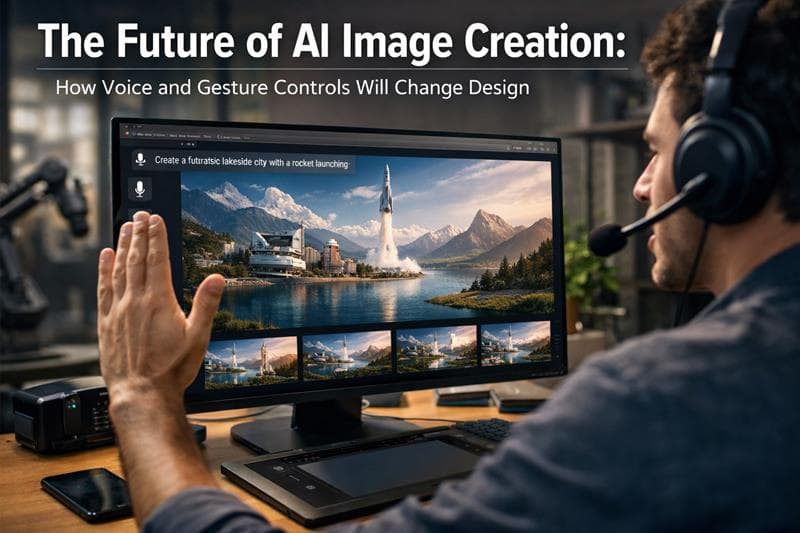
Voice and Gestural Interfaces for AI Image Creation: What’s Coming Next
Artificial intelligence has already transformed how people create digital images. Designers, marketers, and everyday creators now use AI tools to generate visuals within seconds. Most current tools rely on typed prompts, but the next wave of innovation is moving toward voice and gestural interfaces for AI image creation.
Instead of typing a description, users will soon be able to speak commands or use simple hand gestures to generate and modify images instantly. This shift will make AI design tools faster, more intuitive, and more accessible to a wider audience.
In this article, we explore how voice and gesture driven interfaces will change the future of AI image generation and what creators can expect in the coming years.
The Evolution of AI Image Creation Interfaces
The first generation of AI image generation tools required detailed written prompts. Users had to experiment with wording, style descriptions, and technical parameters to get the right output.
Over time, platforms improved prompt understanding and simplified workflows. Today, modern tools already support:
text to image generation
prompt editing and style controls
image variations and enhancements
However, the next evolution focuses on natural user interfaces that reduce friction between human creativity and AI systems.
Voice commands and gesture recognition are becoming key components of this transformation.
Why Voice Interfaces Are the Next Step in AI Creativity
Voice technology has advanced rapidly thanks to improvements in speech recognition and natural language processing. As a result, voice-controlled AI art is becoming a realistic feature for creative platforms.
Instead of typing a prompt, a user could say:
"Create a futuristic city skyline at sunset with neon lights and flying cars."
The AI system would instantly generate visuals based on the spoken description.
Benefits of Voice Based Image Generation
1. Faster creative workflow
Speaking is significantly faster than typing. Designers can experiment with ideas quickly without interrupting their creative flow.
2. Hands free creation
Voice prompts allow creators to generate visuals while multitasking. This is particularly useful for artists using drawing tablets or design software.
3. More natural brainstorming
When people think creatively, they often speak ideas out loud. Voice driven AI tools allow creators to capture those ideas immediately.
4. Accessibility improvements
Voice interfaces make AI design tools more accessible for people with mobility or typing limitations.
These advantages are pushing many developers to explore voice prompts for AI image generation as a core feature in future design platforms.
Gesture Control Is Redefining AI Design Interaction
While voice commands help generate images, gesture controls will help users modify and refine them visually.
Gesture based image generation allows users to interact with AI using hand movements, touchless controls, or motion tracking.
For example:
Swiping a hand could change image variations
Pinching in the air could zoom into details
Rotating a hand could adjust image perspective
Drawing a shape in the air could modify composition
This type of interface is already being explored in multimodal AI systems and spatial computing environments.
Advantages of Gesture Based AI Design
1. More intuitive interaction
Humans naturally communicate through gestures. Using gestures to manipulate visuals feels more direct than navigating menus.
2. Improved creative control
Designers can refine images dynamically without repeatedly editing prompts.
3. Enhanced collaboration
Gesture interfaces work well in collaborative environments were teams brainstorm visuals together.
As gesture recognition technology improves, these interfaces will become an important part of next generation AI design tools.
The Rise of Multimodal AI Creative Systems
The future of AI image creation will not rely on a single input method. Instead, platforms will combine multiple interaction styles in a multimodal AI environment.
Users may interact with AI through:
voice commands
typed prompts
gestures
sketch inputs
image references
For example, a creator could say:
"Generate a fantasy castle in the mountains."
Then they could use gestures to adjust the layout, add towers, or modify lighting.
This blended workflow will make AI powered design tools significantly more powerful and user friendly.
Real World Applications for Voice and Gesture Driven AI
The adoption of voice and gesture interfaces will expand AI creativity beyond traditional design workflows.
1. Marketing and Content Creation
Marketing teams can rapidly create social media visuals using spoken prompts and quick adjustments through gestures.
2. E commerce Product Visuals
Businesses can generate product mockups and marketing visuals faster using hands free image generation.
3. Game Development
Game designers can prototype environments and characters instantly using gesture-controlled modifications.
4. Education and Training
Students can explore creative ideas without needing technical design skills.
These use cases highlight the growing demand for future AI creativity interfaces that reduce complexity and improve speed.
Challenges That Still Need to Be Solved
Despite the exciting potential, several challenges remain before voice and gesture interfaces become standard in AI image generation platforms.
1. Accuracy of voice prompts
Speech recognition systems must accurately interpret creative descriptions and artistic terms.
2. Gesture recognition precision
Gesture tracking technology needs to detect movements reliably without requiring specialized hardware.
3. Context understanding
AI must understand the context of spoken instructions when modifying images.
4. User learning curve
New interaction models require intuitive design so users can adapt quickly.
Technology companies are actively working on these challenges, which means significant improvements are expected soon.
What This Means for the Future of AI Creativity
The shift toward voice and gestural interfaces for AI image creation represents a major step in the evolution of creative technology.
Instead of interacting with AI through complex prompts and menus, users will communicate naturally through speech and movement.
This change will:
accelerate creative workflows
expand accessibility for non-designers
enable faster experimentation
make AI tools more intuitive and human centered
As AI continues to evolve, the line between imagination and visual creation will become even smaller.
Conclusion
Voice and gesture driven technology is set to redefine how people interact with AI powered creative tools. These innovations will transform traditional design workflows and make image generation faster, easier, and more intuitive for everyone.
For businesses, creators, and marketers, adopting these emerging technologies early can provide a powerful competitive advantage.
If you want to experience the next generation of AI image generation tools, explore how modern platforms are simplifying visual creation with advanced AI capabilities.
Start creating smarter visuals today with Genimager and unlock the future of AI powered design.