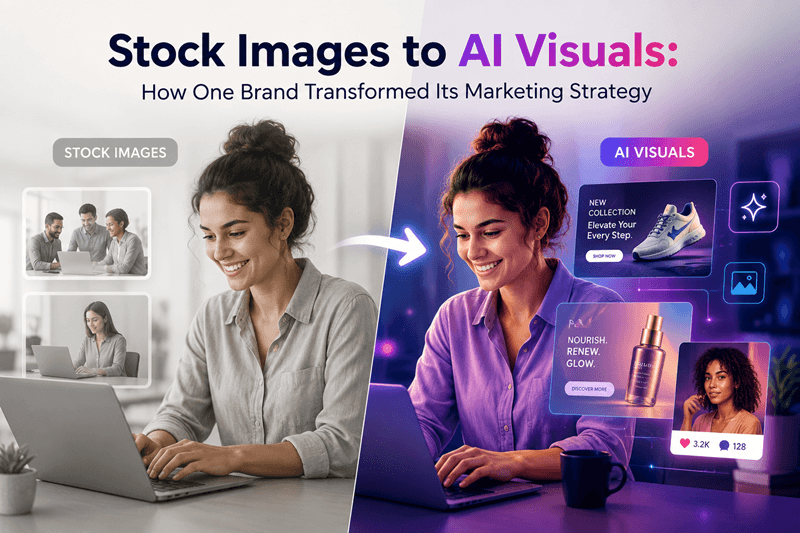
From Stock Images to AI Visuals: A Brand Transformation Case Study
In today's digital landscape, visuals have become one of the biggest factors influencing customer engagement. Whether someone is scrolling through social media, browsing an online store, or reading a blog, images are often the first thing they notice. However, many businesses still rely on generic stock photos that look familiar, overused, and disconnected from their brand identity.
The rise of AI image generation is changing this approach. Instead of searching through thousands of stock photos, businesses can now create unique, high-quality visuals tailored specifically to their campaigns. This shift is helping brands improve consistency, increase engagement, and significantly reduce creative production time.
In this case study, we'll explore how a business transformed its marketing strategy by moving from traditional stock images to AI-generated visuals, and what lessons every marketer can learn from this transition.
Why Stock Images Are No Longer Enough
For years, stock photography was the fastest solution for creating marketing assets. While convenient, it also came with several limitations.
Common challenges include:
Generic-looking visuals that fail to stand out
Repeated use across multiple websites
Limited customization options
Expensive licensing for premium collections
Inconsistent brand identity across campaigns
Customers today expect authentic and personalized experiences. Seeing the same smiling business team or office photo on multiple websites reduces trust and weakens brand recognition.
As visual-first platforms continue to dominate online marketing, businesses need original content that reflects their unique identity.
The Brand's Initial Challenge
Imagine a growing SaaS company launching new marketing campaigns every month.
Their design workflow relied heavily on premium stock libraries. Although the images were visually appealing, several issues emerged:
Blog engagement remained average.
Social media posts blended in with competitors.
Paid advertisements delivered inconsistent click-through rates.
Designers spent hours searching for the "perfect" image.
Creative costs continued increasing.
The marketing team realized they weren't struggling because of poor content. They were struggling because their visuals looked like everyone else's.
That realization led them to explore AI visual content creation.
The Switch to AI-Generated Visuals
Instead of downloading existing images, the team started generating custom visuals using an AI image generator.
Every campaign received unique artwork designed specifically for:
Blog featured images
Landing pages
Product illustrations
Email campaigns
Social media creatives
Advertising banners
Rather than adapting their messaging to available stock photos, they created visuals that matched their exact campaign goals.
This simple workflow changes dramatically improved both efficiency and creative freedom.
What Changed After the Transformation?
1. Stronger Brand Identity
One of the biggest improvements came from visual consistency.
Using AI-generated graphics allowed the marketing team to maintain:
Consistent colors
Similar illustration styles
Matching lighting
Brand-focused compositions
Instead of switching between unrelated stock images, every campaign felt connected.
Customers quickly began recognizing the company's unique visual style.
2. Faster Content Production
Previously, designers spent significant time browsing stock libraries.
Now the process looked much simpler:
Write the campaign brief.
Generate multiple AI image variations.
Select the strongest concept.
Make minor edits if needed.
Publish.
What once required hours could often be completed in minutes.
This faster workflow enabled the team to publish more blog posts, promotional campaigns, and social content without increasing design resources.
3. Higher User Engagement
Unique visuals naturally attract more attention.
After replacing generic stock photography with AI-generated images, the marketing team noticed improvements in several key metrics:
Better blog engagement
Increased time on page
More social media shares
Higher click-through rates
Improved ad performance
While results vary between businesses, original visual content consistently performs better because it offers something audiences haven't already seen elsewhere.
4. Reduced Creative Costs
Premium stock subscriptions, licensing fees, and outsourced illustrations can become expensive over time.
Generating custom visuals with AI significantly reduced these recurring costs while giving marketers greater creative flexibility.
Instead of paying for one licensed image, businesses could create dozens of unique concepts for multiple campaigns.
This made AI especially valuable for startups and growing businesses with limited marketing budgets.
Why AI Visuals Perform Better for Modern Marketing
Today's consumers value originality.
AI-generated visuals support that expectation by allowing marketers to create:
Custom product scenes
Industry-specific illustrations
Branded marketing graphics
Unique blog feature images
Creative social media posts
Personalized advertising assets
Unlike stock photography, AI visuals are built around your message rather than forcing your message to fit an existing image.
This creates a much stronger connection between the visual and the content itself.
Best Practices When Using AI Images
If you're planning to replace stock images with AI-generated content, keep these tips in mind:
Focus on Brand Consistency
Use the same color palette, lighting style, and creative direction across campaigns.
Write Better Prompts
Detailed prompts produce more accurate and visually appealing results.
Include information such as:
Style
Mood
Colors
Camera angle
Background
Subject
Brand tone
Combine AI with Human Creativity
AI should enhance creativity, not replace it.
Marketing teams should still review images for accuracy, branding, and audience relevance before publishing.
Test Different Visual Styles
Experiment with realistic photography, 3D renders, digital illustrations, and cinematic artwork to discover what resonates most with your audience.
Is AI Replacing Stock Images Completely?
Not necessarily.
Stock images still have value for certain use cases, particularly editorial content or situations requiring real-world photography.
However, businesses seeking stronger branding, faster production, and more personalized marketing are increasingly choosing AI-generated visuals.
For many organizations, the ideal approach combines traditional photography with AI-powered creative assets.
The important shift is no longer asking, "Should we use AI?"
Instead, the question becomes:
"How can AI help us create better marketing experiences?"
Final Thoughts
The transition from stock images to AI-generated visuals represents more than a design trend. It reflects a new way of building memorable digital experiences.
Businesses that embrace AI image generation can create original content faster, strengthen their visual identity, reduce production costs, and capture audience attention in increasingly competitive markets.
As AI continues to evolve, brands that invest in unique visual storytelling will be better positioned to stand out across search engines, social media, and digital advertising.
Conclusion: Transform Your Brand with AI-Powered Visuals
Generic stock photos are no longer enough to differentiate your brand. If you want to create engaging blog graphics, eye-catching social media posts, compelling marketing campaigns, and consistent branded visuals, AI offers a smarter and more scalable solution.
Ready to elevate your visual content?
Start creating stunning, original AI-generated images with Genimager and turn every campaign into a memorable brand experience. Explore how Genimager can help you produce professional visuals in minutes, save valuable design time, and give your content the competitive edge it deserves.