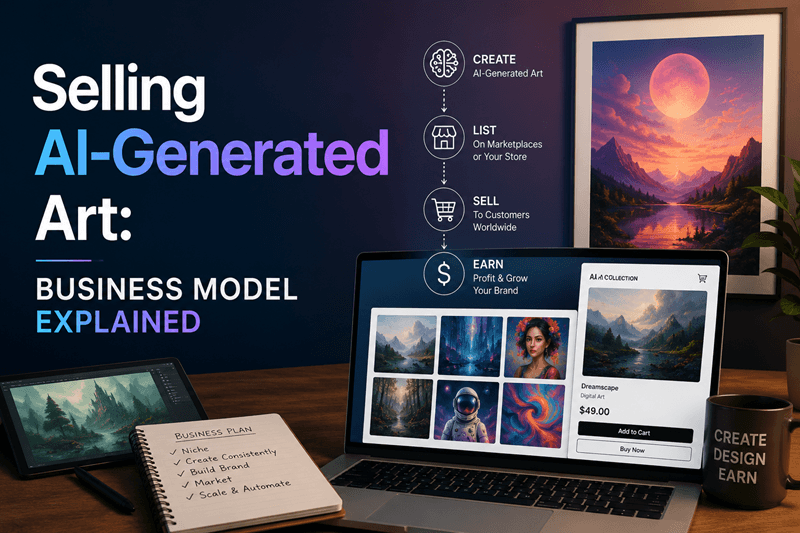
The AI art market has exploded. What once took a professional illustrator days to produce can now be generated in seconds. But here is the question most creators skip straight past: how do you make money from it?
Whether you are a freelance designer, a digital product seller, or a brand building visual content at scale, selling AI-generated art is a legitimate and growing income stream. This guide breaks down the core business models, the best platforms to sell AI artwork, and how to position yourself for sustainable revenue.
Why AI-generated art is a real commercial opportunity
The global digital art market is projected to surpass $10 billion by 2026. Buyers include e-commerce stores, book publishers, app developers, social media brands, and everyday consumers decorating their homes. AI image monetization taps directly into this demand without the overhead of traditional art production.
AI image generators like GenImager let creators produce high-resolution, watermark-free visuals across dozens of styles in seconds, giving sellers a near-unlimited content library at a fraction of traditional production cost.
The opportunity is real. The models below are how smart creators are already capturing it.
The 4 core business models for selling AI art
1. Stock licensing
Sell images on marketplaces for one-time or recurring royalties.
2. Print on demand
Upload artwork to products like mugs, tees, and wall prints.
3. Digital downloads
Sell bundles, packs, or clipart directly to buyers.
4. Client services
Offer custom AI visuals as a freelance or agency service.
1. Stock licensing: passive income at scale
Stock platforms pay royalties every time someone downloads your image. Upload once, earn repeatedly. The key is volume and niche. Generic images compete with millions of uploads. Niche visuals, such as AI-generated product mockups, futuristic food photography, or cultural illustrations, face far less competition and command higher royalty rates.
2. Print on demand: zero inventory required
With print on demand, you upload your AI art, and a fulfillment partner handles printing, shipping, and customer service. Your margin is the difference between the product base price and what the buyer pays. Focus on trending aesthetics, seasonal themes, and niche communities to drive organic discoverability.
3. Digital downloads: high-margin simplicity
Selling AI-generated digital files directly carries no shipping cost and no inventory. Buyers pay for instant access to icons, wallpapers, social media templates, or art bundles. Platforms like Etsy and Gumroad make setup straightforward. Organize your listings around specific use cases to rank in search and convert better.
4. Client services: premium, relationship-based revenue
Brands, authors, and marketing teams constantly need custom visuals at speed. Offering a managed AI image service, where you handle prompt engineering, style matching, and delivery, positions you as a creative partner rather than a commodity seller. Rates for specialized AI art services routinely range from $50 to $500 per project.
Where to sell AI-generated art: top platforms
Etsy - Digital downloads
Adobe Stock - Licensing royalties
Redbubble - Print on demand
Gumroad - Direct sales
Fiverr / Upwork - Client services
Your own site - Full margin
Running your own website alongside marketplace listings is the highest-leverage long-term move. Marketplaces own the traffic relationship. Your own site keeps 100% of the margin and builds a brand that buyers return to.
Realistic revenue benchmarks
Here is what sellers at different stages typically see:
1. Starter - $50–300
per month, 1–3 platforms
2. Growing - $500–2K
per month, niche focus
3. Established - $3K–10K
per month, multi-model
4. Agency-level - $10K+
per month, client retainers
How to launch your AI art business in 5 steps
1. Choose your niche
Fashion, fantasy, food, architecture, or any high-demand vertical. Niche sellers consistently outperform generalists on search-driven platforms.
2. Generate high-quality assets
Use a platform that produces watermark-free, commercially usable images at high resolution. GenImager supports models like Nano Banana 2, Imagen 4, and Flux Schnell, built for exactly this.
3. Verify your usage rights
Always confirm the commercial licensing terms of the AI tool you use. GenImager's platform produces images that users can sell commercially within the platform guidelines.
4. List with SEO-optimized titles and tags
Your listing copy drives discoverability. Use long-tail keywords that match buyer intent: "minimalist botanical print for bedroom wall" beats "plant artwork."
5. Scale across models and platforms
Once one income stream is profitable, replicate the formula. Add a second platform, a second niche, or a client service tier built on your existing workflow.
Pro tip
Batch your image generation sessions. One focused hour with GenImager can produce 50 to 100 publication-ready assets, enough to stock an entire Etsy shop or Adobe Stock portfolio in a single sitting.
The one legal question everyone asks
Can you legally sell AI-generated art? In most jurisdictions, yes, provided you hold the commercial rights to the images and are not infringing on existing copyrighted works or likenesses. Always use a generator that explicitly grants commercial usage rights to outputs. GenImager delivers watermark-free images and does not claim ownership of user-generated content, making it a clean option for commercial sellers.
Conclusion: your AI art business starts with the right tools
Selling AI-generated art is one of the most accessible digital business models available today. Low startup cost, no physical inventory, a global buyer base, and the ability to generate unlimited content on demand. The creators building sustainable income are not the ones with the most artistic talent. They are the ones who picked a niche, built a consistent output system, and chose an AI image generator powerful enough to produce work buyers want to pay for.
GenImager gives you that foundation: multiple cutting-edge models, high-resolution watermark-free output, and a simple coin-based system that scales with your volume.
Start generating sellable AI art today
Join thousands of creators using GenImager to build real income from AI-generated images. No design experience needed, just a great prompt and the right platform.