How Visual Content Impact SEO Rankings in 2026
When users search online, they do not just read headlines and paragraphs. They scan images, explore infographics, watch videos, and look for visual explanations that help them understand information faster. For businesses competing for organic traffic in 2026, visual content has become an important part of a successful SEO strategy.
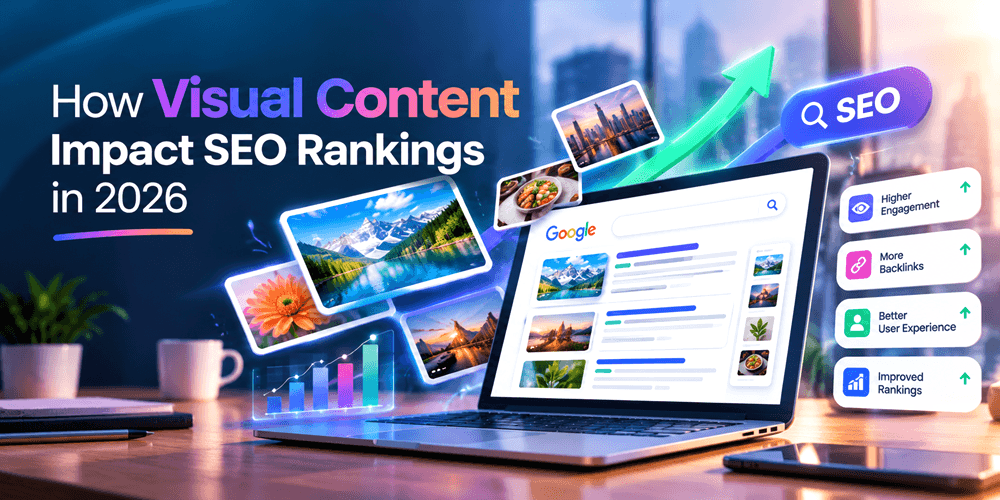
When users search online, they do not just read headlines and paragraphs. They scan images, explore infographics, watch videos, and look for visual explanations that help them understand information faster. For businesses competing for organic traffic in 2026, visual content has become an important part of a successful SEO strategy.
But can images improve your Google rankings?
The answer is yes, when they support useful content and are optimized correctly. Visual assets can help search engines understand your pages, create opportunities to appear in Google Images, improve the user experience, and encourage visitors to explore your website.
From AI-generated images to interactive infographics, businesses now have more ways to create relevant visual content efficiently. The key is knowing which visuals to use and how to optimize them.
In this guide, we will explore how visual content impacts SEO rankings in 2026 and how your business can turn better visuals into stronger search visibility.
What Is Visual Content in SEO?
Visual content includes any visual element that communicates information or supports a webpage's message. It can make complex ideas easier to understand while helping visitors navigate your content.
Common types include:
Images and illustrations: Product photos, blog graphics, and custom artwork.
Infographics: Visual summaries of statistics, processes, and research.
Videos: Tutorials, product demonstrations, and educational explainers.
Charts and diagrams: Comparisons, performance metrics, and step-by-step workflows.
AI-generated visuals: Original images created for blog posts, landing pages, campaigns, and social media.
For SEO, visual content should do more than make a page attractive. It should provide context, answer questions, support the written content, and help visitors accomplish their goals.
5 Ways Visual Content Impacts SEO Rankings in 2026
1. Improves Visibility in Google Images and Visual Search
Visual search gives users another way to discover information online. People can search Google Images, use Google Lens, or upload pictures to find related products, information, and websites.
Well-optimized images can help your pages become discoverable through these search experiences.
To improve image visibility:
Use descriptive filenames such as ai-image-seo-guide.webp instead of IMG001.jpg.
Add accurate, contextual alt text.
Place images near relevant headings and paragraphs.
Use high-quality, relevant visuals that support the page topic.
Ensure important images can be discovered and indexed by search engines.
Google also recommends using standard HTML image elements and providing appropriate image context. These practices help search engines understand your visual assets.
2. Makes Content More Engaging and Useful
Imagine reading a 2,000-word article explaining how AI image generation works without seeing a single example. Even if the writing is informative, understanding the process may take more effort.
Now imagine the same article with a workflow diagram, example outputs, and a comparison of image styles. The information becomes easier to scan and understand.
Useful visuals can help readers:
Understand complicated concepts quickly.
Find answers without reading every paragraph.
Compare products or approaches.
Follow tutorials more confidently.
Remember important information.
These benefits can improve the overall user experience. However, images do not automatically improve rankings, and there is no guaranteed ranking boost from adding more visuals. Relevance and usefulness remain essential.
3. Supports Better Page Experience and Performance
A visually attractive website can still struggle if it loads slowly or shifts around while users interact with it.
Large, unoptimized images can increase page load times and negatively affect the user experience. Google considers page experience and Core Web Vitals among the factors relevant to search performance.
Follow these image optimization practices:
Compress images without sacrificing necessary quality.
Use modern formats such as WebP or AVIF when appropriate.
Serve responsive image sizes for mobile and desktop.
Specify image dimensions to reduce unexpected layout shifts.
Lazy-load below-the-fold images where appropriate.
Prioritize loading the main hero image when it is important to initial page rendering.
Monitor three important Core Web Vitals metrics: Largest Contentful Paint (LCP), Interaction to Next Paint (INP), and Cumulative Layout Shift (CLS).
Good targets are LCP of 2.5 seconds or less, INP below 200 milliseconds, and CLS of 0.1 or less.
4. Creates More Opportunities for Organic Clicks
Visuals can influence how users notice and evaluate your content in search results, particularly when images appear alongside relevant listings or in Google Images.
A distinctive featured image can also make a shared article more appealing across social platforms, potentially introducing your content to new audiences.
To encourage more clicks, create visuals that accurately represent the page's value. For example, an article about AI image tools could feature a clear before-and-after comparison rather than a generic stock photo.
Also optimize your page title, meta description, and social sharing image. Google may generate search snippets and title links automatically, so compelling metadata can help communicate relevance but does not guarantee a higher click-through rate.
5. Strengthens Topical Relevance and Content Understanding
Search engines interpret webpages using multiple signals, including text, links, image information, and surrounding context.
Relevant visuals can reinforce the subject of your article. For example, a blog about e-commerce product photography might include product image examples, lighting diagrams, and an infographic explaining image optimization.
Help search engines understand these assets by combining:
Descriptive alt text.
Relevant image filenames.
Informative captions were useful.
Contextual placement near related content.
Appropriate image metadata and structured data when applicable.
Avoid keyword stuffing. Your goal is to describe each image accurately, not to repeat the same target keyword everywhere.
How to Optimize Visual Content for SEO in 2026
Use this practical checklist before publishing your next blog post.
Step 1: Match visuals to search intent. Identify what readers need to understand and create images that directly answer those questions.
Step 2: Create original, useful assets. Use custom illustrations, diagrams, comparisons, or AI-generated images instead of relying entirely on generic stock photography.
Step 3: Optimize image metadata. Write descriptive filenames and natural alt text that explains meaningful image content.
Step 4: Improve loading performance. Compress files, choose suitable formats, and test mobile performance using PageSpeed Insights.
Step 5: Make visuals accessible. Use sufficient contrast, readable labels, and text alternatives for informative graphics. Decorative images generally need empty alt attributes.
Step 6: Measure results. Use Google Search Console to monitor impressions, clicks, click-through rate, and image or visual-search performance where reporting is available. Compare results before and after significant changes.
How AI-Generated Images Can Support Your SEO Strategy
Creating custom visuals for every article can consume significant time and resources. AI image generators offer businesses another way to produce relevant artwork, illustrations, thumbnails, and campaign graphics.
With GenImager, marketers can explore AI-generated visuals tailored to their content needs. Instead of searching endlessly for a suitable stock image, teams can create concepts that align more closely with an article's topic and visual identity.
For example, a SaaS company publishing a guide about workflow automation could generate a custom illustration showing how different tools connect. A marketing team could also create blog feature images and supporting graphics that maintain a consistent visual style.
However, AI-generated images are not an automatic SEO shortcut. Their value depends on originality, relevance, quality, accessibility, and how well they support the surrounding content.
The objective is not simply to publish more images. It is to create better visual experiences that help users find and understand useful information.
Frequently Asked Questions
1. Does visual content directly improve Google rankings?
Not automatically. Relevant, well-optimized images can support image search visibility, accessibility, and page experience. Rankings still depend on multiple factors, including content relevance and overall usefulness.
2. How many images should an SEO blog post contain?
There is no fixed ideal number. Include enough visuals to explain important concepts, break up long sections, or demonstrate a process. Every image should serve a purpose.
3. Are AI-generated images good for SEO?
Yes, they can be useful when they are relevant, high-quality, and created to help readers. Focus on usefulness and accuracy rather than the method used to generate the image.
4. What is the most important image SEO factor?
Start with relevance and accessibility. Use meaningful visuals, descriptive alt text, appropriate placement, and optimized file sizes. These fundamentals provide a strong foundation for image SEO.
Conclusion: Turn Better Visuals into Better SEO Opportunities
In 2026, visual content is more than a design element. It can help businesses improve image discoverability, explain complex ideas, strengthen user experience, and create additional opportunities for organic traffic.
The most effective strategy combines original visuals with useful written content, descriptive image metadata, fast-loading pages, and consistent performance measurement. Remember that no single image guarantees higher rankings. Sustainable SEO growth comes from delivering value to your audience.
Ready to create visuals that make your content stand out? Explore GenImager and discover how AI-generated images can help your team create engaging blog graphics, marketing visuals, and content assets more efficiently. Start building a stronger visual content strategy today.