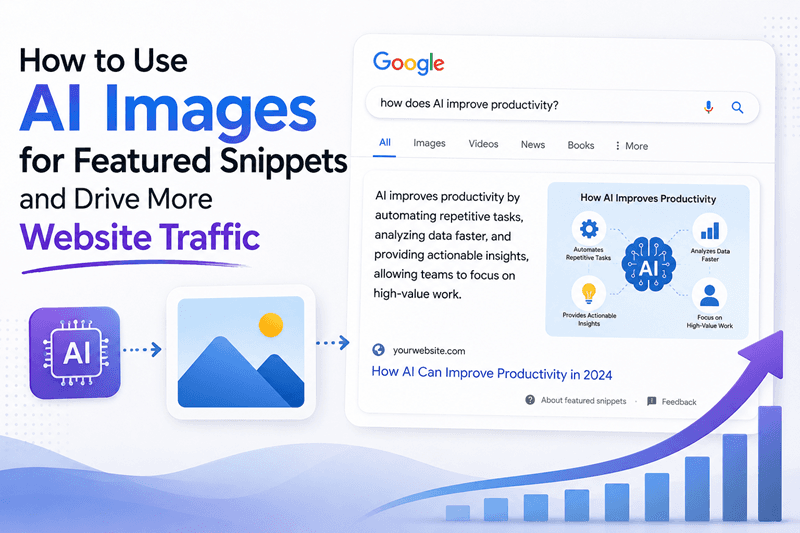
Featured snippets are among the most valuable positions in Google Search. Often called "Position Zero," these search results appear above traditional organic listings and attract significant attention from users.
While most marketers focus on optimizing text for featured snippets, visual content is becoming increasingly important. Google frequently displays relevant images alongside snippet content, creating a powerful opportunity for brands to increase visibility and clicks.
This is where AI-generated images can provide a competitive advantage.
In this guide, you'll learn how to use AI images strategically to improve your chances of appearing in featured snippets and driving more organic traffic.
What Are Featured Snippets?
Featured snippets are selected search results that Google displays at the top of the search engine results page (SERP) to answer a user's query quickly.
Common featured snippet formats include:
Paragraph snippets
List snippets
Numbered step-by-step snippets
Table snippets
Video snippets
Google often pairs these snippets with an image that helps explain the answer visually.
Example
If someone searches:
"How does email marketing automation work?"
Google may show:
A concise text explanation
A supporting image illustrating the automation workflow
The image may come from a different website than the text source, creating additional opportunities for brands.
Why AI Images Matter for Featured Snippets
Visual search and user experience are becoming increasingly important ranking factors.
AI-generated images can help you:
Improve content engagement
Increase click-through rates (CTR)
Provide unique visuals not used by competitors
Support complex concepts with easy-to-understand graphics
Enhance topical authority
When Google identifies an image that clearly supports a search query, it may display that image alongside featured snippet content.
This means your image could appear at the top of search results even if your page is not currently holding the snippet itself.
How Google Chooses Images for Featured Snippets
Although Google does not reveal its exact selection process, SEO studies suggest several key factors influence image selection:
Relevance
The image must directly support the search query and surrounding content.
Context
Google analyzes nearby headings, captions, alt text, and body content.
Quality
High-resolution images tend to perform better than low-quality graphics.
Originality
Unique visuals often outperform generic stock photos.
User Experience
Images should load quickly and display properly on all devices.
AI-generated images can satisfy all of these requirements when created strategically.
5 Ways to Use AI Images for Featured Snippet Optimization
1. Create Visual Explanations for Complex Topics
Many featured snippets answer "how-to" or educational queries.
Instead of relying on stock photos, use AI image generators to create custom visuals that explain concepts clearly.
Examples include:
Marketing funnels
SaaS workflows
Customer journey maps
SEO processes
Product comparisons
The more directly your image answers the search query, the more likely Google is to consider it relevant.
2. Match Images to Search Intent
Search intent is critical for snippet optimization.
Ask yourself:
What is the user trying to understand?
For informational searches:
Use diagrams
Use infographics
Use educational illustrations
For comparison searches:
Create side-by-side comparison visuals
For process-based searches:
Design step-by-step graphics
AI image tools like Genimager make it easy to generate visuals tailored to specific search intent.
3. Optimize Image Alt Text
Many websites neglect image SEO.
Every AI-generated image should include descriptive alt text containing relevant keywords naturally.
Example:
Bad Alt Text:
image1.png
Good Alt Text:
AI-generated workflow showing how featured snippets improve organic search visibility
This helps Google understand the image content and improves accessibility.
Quick Checklist for AI Image SEO
Before publishing your content, make sure every AI-generated image follows these SEO best practices:
✔ Create a unique AI-generated image that directly supports the topic.
✔ Use a descriptive file name that includes your target keyword where appropriate.
✔ Add clear, keyword-rich alt text that accurately describes the image.
✔ Compress image files to improve page loading speed and user experience.
✔ Place images close to the relevant heading or content section they support.
✔ Ensure images display properly on both desktop and mobile devices.
✔ Use high-resolution visuals that remain clear across different screen sizes.
✔ Include supporting text, captions, or context around the image to help search engines understand its relevance.
✔ Avoid generic stock-style visuals when a custom AI-generated image can better explain the topic.
✔ Regularly review image performance and update visuals as search trends evolve.
Pro Tip: The most effective AI images for featured snippets are those that visually answer the user's question. If your image helps explain a concept faster than text alone, Google is more likely to consider it relevant for snippet placement.
4. Use AI-Generated Infographics
Infographics continue to perform well in search because they condense information into an easily digestible format.
Popular infographic topics include:
SEO checklists
Marketing frameworks
Industry statistics
Workflow processes
Product tutorials
AI tools can significantly reduce the time required to create professional-quality infographics.
These visual assets also attract backlinks, which can further strengthen your SEO performance.
5. Place Images Near Featured Snippet Content
Image placement matters.
When creating content designed for snippets:
Add the image immediately after the target heading
Include a concise explanation nearby
Use structured formatting
Maintain topical relevance
For example:
How AI Images Improve Featured Snippets
Follow the heading with:
A concise answer paragraph
An AI-generated supporting image
Additional details below
This structure helps search engines connect the image with the answer.
Best Types of AI Images for Featured Snippets
Certain image formats tend to perform exceptionally well:
Process Diagrams
Perfect for:
How-to guides
Tutorials
Workflow explanations
Comparison Graphics
Ideal for:
Product comparisons
Feature breakdowns
Pros and cons content
Data Visualizations
Great for:
Statistics
Research reports
Industry trends
Educational Illustrations
Useful for:
SaaS products
Technical concepts
Digital marketing topics
Using a mix of these visual formats can increase your opportunities to appear in featured snippets across multiple keyword categories.
Common Mistakes to Avoid
Many marketers undermine their image SEO efforts by making these mistakes:
Using generic stock photos
Ignoring alt text optimization
Uploading oversized image files
Creating irrelevant visuals
Failing to align images with search intent
Reusing identical images across multiple pages
AI-generated visuals solve many of these problems by providing unique, highly relevant imagery tailored to your content.
The Future of Featured Snippets and AI Images
As search engines continue evolving toward visual-first experiences, images will play an even greater role in search visibility.
AI-generated visuals allow businesses to create custom, scalable, and highly relevant content assets faster than ever before.
Brands that combine strong SEO copywriting with strategic AI image optimization will be better positioned to capture featured snippets, increase organic visibility, and improve user engagement.
Conclusion
Featured snippets are no longer just about text. Google's growing emphasis on visual content means that optimized images can significantly influence search performance and click-through rates.
By creating relevant AI-generated visuals, optimizing image SEO elements, matching search intent, and strategically placing images within your content, you can improve your chances of earning valuable featured snippet exposure.
Ready to create SEO-friendly AI images that help your content stand out in search results?
Start using Genimager today and generate high-quality, optimized visuals that drive more traffic, increase engagement, and support your SEO growth strategy.