How Real Estate Developers Use AI Image Generation to Showcase Projects Before Construction with Genimager
Real estate remains one of the most visually driven industries in the global economy. At its core, property acquisition is an emotional and aspirational journey; buyers make life-altering decisions based on how a space looks, feels and fits their future expectations. Genimager, a scalable and business-aligned AI platform, allows developers to create hyper-realistic, contextual visuals that showcase projects with stunning detail before construction even begins.
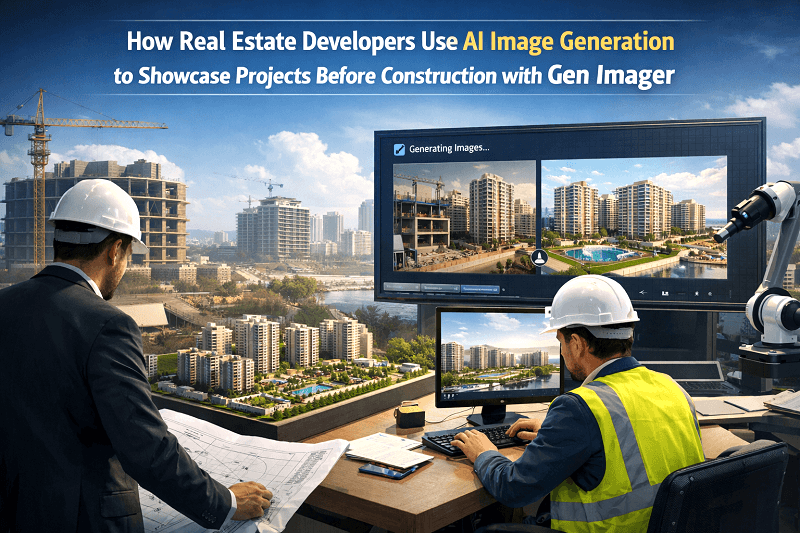
Real estate remains one of the most visually driven industries in the global economy. At its core, property acquisition is an emotional and aspirational journey; buyers make life-altering decisions based on how a space looks, feels and fits their future expectations. However, a persistent challenge defines the sector: the vast majority of high-value properties are marketed, sold and financed long before the first brick is laid.
Traditionally, developers have relied on a combination of technical architectural renders, physical brochures and static sample images to communicate their vision. While effective, these assets are notoriously expensive, time-consuming to produce and offer very little room for variation once the initial "render" is complete. In 2026, as the pace of urban development accelerates and competition for buyer attention intensifies, developers require a faster, more flexible methodology for project presentation.
This is where AI image generation for real estate marketing is fundamentally changing the scene. Genimager, a scalable and business-aligned AI platform, allows developers to create hyper-realistic, contextual visuals that showcase projects with stunning detail before construction even begins. In a market where perception drives value, the ability to engage in high-level visual storytelling has become a critical differentiator for success.
The Visualization Challenge in Real Estate
The primary hurdle in off-plan sales is the "imagination gap." Most prospective buyers struggle to translate flat 2D floor plans or complex technical drawings into a lived experience. While these documents provide essential data, they lack the emotional impact and "vibe" that triggers a purchase decision.
Standard 3D rendering has long been the industry's answer to this problem, but it comes with significant operational friction. High-end rendering requires specialized labor, expensive software licenses and weeks of back-and-forth revisions for even the smallest lighting or furniture change. On the other end of the spectrum, generic consumer AI tools like Midjourney or Stable Diffusion can generate beautiful, "dreamy" houses, but they often lack the structural consistency and project-specific accuracy required for a professional real estate offering.
This creates a disconnect between the developer’s concept and the customer’s perception. When a buyer cannot clearly see the final product, their decision-making slows down and their perceived risk increases, often leading to stalled sales cycles and missed revenue targets.
How Genimager Transforms Real Estate Visualization
The integration of Genimager into the development workflow allows real estate firms to bypass traditional bottlenecks and create a more dynamic sales environment.
1. Creating Pre-Construction Visual Experiences
Developers can use Genimager to generate visuals that place their properties in realistic, real-world contexts. This goes beyond just the building itself; it includes the exact play of natural light in the interiors, the specific textures of the exterior cladding and even the surrounding urban or natural environments. By providing a "finished" look at a project during the pre-construction phase, developers significantly improve buyer confidence and secure early-stage commitments.
2. Personalizing Property Presentation
A major shift in modern real estate is the demand for personalization. One buyer may be looking for a sleek, minimalist bachelor pad, while another envisioning a warm, traditional family home in the same building. With AI image generation for real estate, developers can instantly generate multiple interior design variations modern, luxury, industrial or classic for the same unit. This level of personalization enhances engagement and allows the sales team to show a buyer exactly what their future home could look like, rather than a generic model.
3. Enhancing Marketing Campaigns
Real estate marketing now lives almost entirely on digital channels Instagram, LinkedIn and specialized property portals. Genimager enables marketing teams to generate high-volume, campaign-ready visuals in seconds. This supports rapid A/B testing for digital ads, landing pages and social media content without the need for a dedicated rendering team or an expensive physical photoshoot of a "staged" unit. The result is a more agile marketing strategy that can pivot as fast as the market moves.
Why AI Image Generation Matters in Real Estate Growth
The real estate industry is undergoing a digital-first evolution. Statistics show that over 90% of buyers now explore properties online before ever requesting a physical site visit or meeting an agent. In this digital storefront, visual quality isn't just a bonus it is the primary factor in capturing initial interest.
AI-powered image generation for real estate developers allows for continuous content creation. As a project evolves or as design trends shift, developers can update their marketing materials without the typical "render delay." Unlike generic creative tools, Genimager provides structured, repeatable outputs that maintain a consistent aesthetic across an entire development portfolio, making it a professional-grade solution for businesses operating at scale.
Business Impact for Real Estate Developers
Real estate firms adopting Genimager gain a measurable operational advantage. By marketing properties more effectively and earlier in the lifecycle, developers can hit their "pre-sale" targets faster, which is often a requirement for securing construction financing.
Furthermore, personalized visuals have been shown to increase buyer engagement and shorten the decision-making cycle by removing the uncertainty of the "unfinished" space. On the balance sheet, the reduction in high-end design and rendering costs improves the overall profitability of the project. When sales teams are equipped with better visual tools to communicate value, they move from "telling" the buyer about the property to "showing" them their future life within it.
The Future of Real Estate Visualization
As we look toward the end of the decade, property visualization will become increasingly interactive and bespoke. We are moving toward a future where AI-generated visuals will integrate seamlessly with virtual reality (VR) tours and augmented reality (AR) experiences, allowing buyers to customize their floorings, wall colors and kitchen layouts in real-time.
Genimager positions developers to lead this change, providing the scalable visual engine needed to support both high-level marketing and granular sales customization. In an industry where the stakes are high and the competition is fierce, the ability to show not just tell will remain the ultimate indicator of success.
FAQs
Q1: Can Genimager replace 3D rendering?
No. It is a complementary tool. While high-end 3D rendering is still used for final architectural specifications, Genimager is significantly faster and more cost-effective for conceptual exploration, marketing content and personalized sales visuals.
Q2: Is it useful for under-construction projects?
Absolutely. It is specifically designed to help buyers visualize the finished product while the site is still in the "concrete and crane" phase, which is when most of the critical sales activity occurs.
Q3: How does it compare to Midjourney for real estate?
While Midjourney produces generic artistic houses, Genimager focuses on structured, project-aligned outputs. It allows developers to maintain consistency with actual architectural plans and brand standards, which is necessary for professional use.
Q4: Can developers personalize visuals for buyers?
Yes. One of the strongest features of the platform is the ability to generate multiple interior design styles for the same layout, allowing agents to cater to the specific tastes of different leads.
Q5: Does this improve property sales?
Yes. Better visualization leads to higher engagement rates on digital platforms and increased buyer confidence, both of which directly correlate with higher conversion rates and faster closing times.