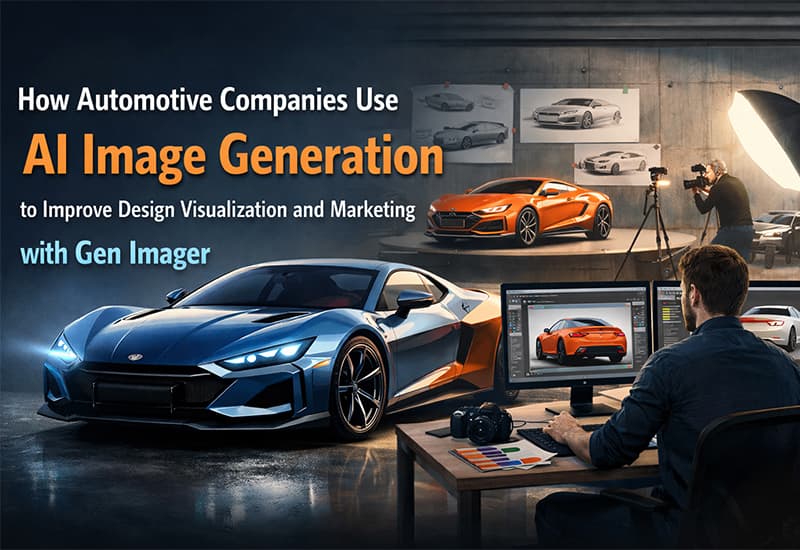
The automotive industry has always been defined by a relentless pursuit of design excellence, technical precision and cutting-edge innovation. From the initial sketches of a concept vehicle to the final production models rolling off the assembly line, visual representation is the core of the sector. High-fidelity visuals are crucial for conveying complex engineering ideas, refining aerodynamic aesthetics and building consumer anticipation long before a car ever touches the pavement. In 2026, as the transition to electric and autonomous platforms accelerates, the demand for rapid, high-quality visual storytelling has never been greater.
However, the traditional process of creating premium automotive imagery is notoriously time-intensive and cost-prohibitive. Design departments currently rely on heavy 3D rendering clusters that require hours of processing time, while marketing teams are often forced to wait for physical prototypes to conduct expensive global photoshoots. As product lifecycles shrink and global competition intensifies, these legacy workflows are becoming significant bottlenecks. Studios can no longer afford to wait weeks for a single set of refined renders when the market moves in days.
This is where AI image generation for automotive companies is fundamentally transforming professional workflows. Genimager, a business-focused generative platform, allows automotive brands to produce contextual, high-quality visuals that support every stage of the lifecycle. By enabling design exploration and marketing preparation to happen simultaneously, Genimager ensures that creative vision and commercial strategy move at the same lightning speed as the vehicles themselves.
The Visualization Challenge in the Automotive Industry
Automotive companies operate within a high-stakes visual ecosystem where a single design curve or interior texture can define a brand's success. During the early "Blue Sky" phase of development, teams must explore hundreds of permutations for exterior styling, cockpit ergonomics and lighting signatures. These concepts aren't just for show; they must be effectively communicated to stakeholders, mechanical engineers and executive leadership to secure multi-million-dollar investments.
Traditional rendering workflows, while accurate, are often too rigid for the fluid nature of early-stage ideation. Even a minor tweak to a grille or a headlight housing can necessitate a total re-render of a scene, draining both time and computational resources. Simultaneously, marketing departments face the "pre-production gap," where they need high-impact visuals for teaser campaigns and investor decks months before a functional vehicle even exists for a camera to capture.
While generic creative tools like Midjourney, DALL·E or Stable Diffusion can produce striking car-like images, they frequently fall short of professional standards. They often lack brand alignment, struggle with structural consistency and fail to respect the functional geometry required in a production environment. For a global automaker, an image that looks "cool" but is technically impossible to build is a liability. There is a clear need for a tool that bridges the gap between raw creative power and business-ready accuracy.
How Genimager Supports Automotive Design and Marketing
The integration of Genimager into the automotive pipeline allows brands to bypass traditional production friction, offering a suite of specialized capabilities for modern teams.
1. Accelerating Concept Design Visualization
In the initial stages of vehicle architecture, speed is the ultimate competitive advantage. Designers must iterate through various proportions, silhouettes and visual identities to find a brand's future "face." With Gen Imager, teams can generate dozens of high-fidelity design interpretations from simple descriptive inputs. Instead of waiting days for a 3D department to update a model, a lead designer can visualize a "rugged electric SUV with a minimalist glass roof" in seconds, allowing for immediate feedback and direction.
2. Enhancing Pre-Launch Marketing Campaigns
Modern automotive marketing starts the moment a project is greenlit. Brands use AI image generation for automotive marketing to create campaign-ready assets for digital launches and social media teasers long before the first chassis is welded. This capability reduces the heavy dependency on early, secretive photoshoots and allows marketing teams to execute global digital strategies across multiple regions and environments from neon lit cityscapes to rugged mountain passes without ever leaving the office.
3. Supporting Feature and Technology Communication
As vehicles evolve into "computers on wheels," explaining invisible technologies like LiDAR-based autonomous driving or complex augmented reality (AR) dashboards becomes a massive communication challenge. Genimager enables brands to generate contextual visuals that demonstrate these abstract features in realistic, real-world scenarios. This improves consumer literacy and turns a dry technical spec sheet into a compelling, visual narrative that justifies a premium price point.
Why AI Image Generation Matters in Automotive Innovation
The global automotive landscape is currently undergoing its most significant shift since the assembly line: the rise of software-defined electric vehicles and connected ecosystems. As products become more complex and "tech-heavy," the need for clear, instantaneous visual communication has expanded beyond just the look of the car. It now encompasses the entire user experience.
AI-powered image generation for automotive workflows helps bridge the engineering gap. It allows a specialist to communicate a revolutionary new battery cooling layout or a modular interior concept to a non-technical board of directors with total clarity. Unlike generic consumer tools, Genimager focuses on structured, business-aligned generation, ensuring that every output is professional, brand-consistent and ready for use in a corporate environment.
Business Impact for Automotive Companies
Automotive brands that integrate Genimager into their daily operations gain a massive operational edge. Design teams can "fail fast" and iterate through a year's worth of ideas in a single month, drastically reducing development bottlenecks. Marketing teams can achieve an earlier "time-to-market" by having a full library of promotional content ready the moment a vehicle is announced, rather than months later.
This increased agility directly impacts the bottom line by reducing the costs associated with physical prototyping and global site scouting for photoshoots. Furthermore, the ability to maintain visual consistency across every touchpoint from the website to the dealership showroom strengthens the brand's identity and fosters a deeper sense of consumer trust. In an industry where differentiation is everything, these AI-driven efficiencies are becoming the new standard for success.
The Future of AI in Automotive Visualization
Looking toward the end of the decade, digital tools will move from being "assistants" to becoming core components of the design DNA. We expect AI image generation to integrate directly with CAD (Computer-Aided Design) software, allowing a designer to sketch a line and have the AI instantly "skin" it with realistic textures and environmental reflections.
Genimager acts as the crucial bridge in this evolution. It allows companies to move from static, slow-moving processes to a fluid, real-time creative workflow. Rather than replacing the skilled artists and designers who have defined the industry for a century, AI enhances their capabilities adding the speed, flexibility and global scalability required to design the next generation of mobility.
FAQs
Q1: Can Genimager replace automotive design software?
No. It is a complementary tool. While CAD and professional rendering software are needed for engineering and final production, Genimager accelerates the early-stage visualization and communication phases where speed is more important than millimetric precision.
Q2: Is AI image generation accurate for vehicle design concepts?
It is highly accurate for conceptual exploration, aesthetic direction and marketing storytelling. However, it should not be used as a substitute for final engineering specifications or safety testing models.
Q3: How does Genimager differ from Midjourney for automotive use?
While Midjourney is fantastic for artistic "vibe" checks, Genimager is built for business. It prioritizes structural consistency, brand alignment and the specific lighting/material requirements that automotive professionals demand.
Q4: Can automotive marketing teams use Genimager?
Absolutely. It is an essential tool for creating pre-launch teaser content, social media assets and educational visuals that explain new vehicle technologies to the public.
Q5: Does this reduce production timelines?
Yes. By shortening the "iteration loop" in design and allowing marketing teams to work in parallel with engineering, it significantly reduces the total time required to bring a vehicle from concept to a public reveal.