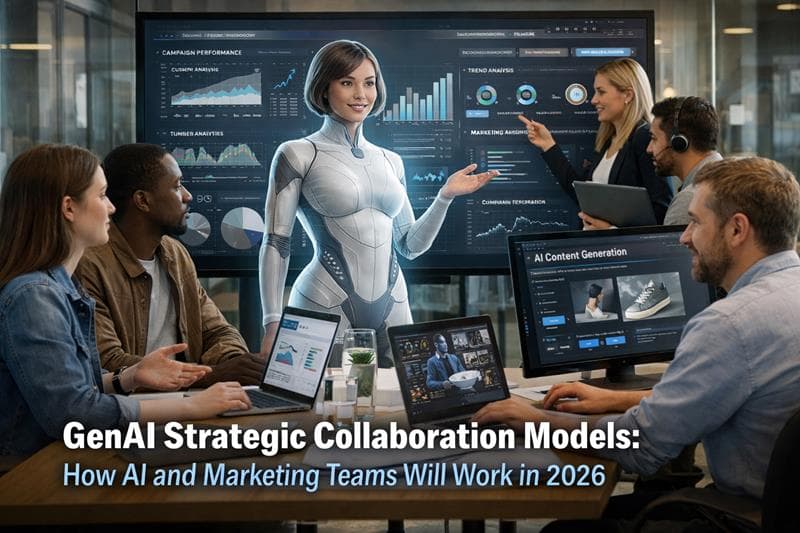
The relationship between artificial intelligence and marketing teams is evolving faster than ever. In 2026, the conversation is no longer about replacing humans with AI. It is about building GenAI collaboration models that combine human creativity with machine efficiency.
If you are running a SaaS product like Genimager or managing digital campaigns, this shift is not optional. It is your competitive advantage.
So how exactly will AI marketing teams function in 2026? And how can you implement these models today?
Let’s break it down.
The Shift from Tools to Teammates
In the early 2020s, generative AI tools were used for isolated tasks like writing blog drafts or generating images. In 2026, AI is embedded as an active collaborator.
Instead of asking, “Which tool should I use?”, teams now ask:
“How should AI and humans divide responsibilities?”
Key transformation:
AI handles speed, scale, and data processing
Humans focus on strategy, creativity, and emotional intelligence
This shift defines modern AI collaboration strategies.
4 Core GenAI Collaboration Models in 2026
1. AI as a Creative Partner
In this model, AI is involved from ideation to execution.
Workflow example:
Marketer inputs campaign goal
AI generates content variations
Human refines messaging and tone
This approach is widely used in AI content creation tools like Genimager for generating visuals and campaign creatives.
Why it works:
Faster brainstorming
Reduced creative fatigue
More experimentation
Ask yourself: Are you still using AI only for final output instead of ideation?
2. AI as a Workflow Orchestrator
Here, AI manages the entire AI content workflow across channels.
What it does:
Assigns tasks
Suggests content calendars
Tracks campaign performance
Optimizes publishing schedules
This is where marketing automation AI becomes powerful.
Example use case:
A SaaS marketing team launches a product campaign:
AI schedules blog posts
AI generates social snippets
AI tracks engagement and suggests improvements
Result:
Higher consistency and better campaign ROI.
3. Human-in-the-Loop Model
This is the most balanced and scalable human AI collaboration approach.
How it works:
AI generates drafts, visuals, or insights
Humans validate, edit, and approve
This model is critical for:
Brand voice consistency
Compliance and accuracy
High quality outputs
Why it matters:
AI is fast, but humans ensure relevance.
If your team skips this step, you risk generic content that does not convert.
4. AI as a Data Strategist
In 2026, AI is not just creating content. It is shaping strategy.
Capabilities:
Predicting customer behavior
Identifying high converting keywords
Recommending campaign direction
For example:
AI can analyze user engagement and suggest:
Which visuals perform best
Which blog topics drive conversions
Which landing pages need optimization
This is a game changer for AI driven campaigns.
How Hybrid Teams Operate in 2026
Modern AI marketing teams are structured differently than traditional teams.
Typical team structure:
AI Strategist
Oversees AI workflows and integrations
Content Marketer
Focuses on storytelling and brand voice
AI Tool Specialist
Works with platforms like Genimager
Performance Analyst
Uses AI insights for optimization
Daily workflow:
AI generates insights and ideas
Team selects and refines strategy
AI executes content production
Humans optimize and personalize
This creates a loop of continuous improvement.
Key Benefits of GenAI Collaboration Models
1. Speed at Scale
Teams can produce 10x more content without increasing headcount.
2. Data Driven Decisions
AI removes guesswork by providing real time insights.
3. Higher Conversion Rates
Personalized and optimized campaigns perform better.
4. Cost Efficiency
Reduced dependency on large creative teams.
Challenges You Must Address
While the benefits are clear, there are challenges.
1. Over Reliance on AI
Too much automation can lead to generic content.
2. Skill Gap
Teams need training to use AI effectively.
3. Workflow Complexity
Without clear processes, AI can create chaos instead of efficiency.
Solution: Start with a clear collaboration framework instead of random tool adoption.
Best Practices to Build Your AI Collaboration Strategy
1. Define Roles Clearly
Decide what AI does and what humans own.
2. Use AI for First Drafts
Save time and focus human effort on refinement.
3. Maintain Brand Guidelines
Ensure consistency across AI generated content.
4. Continuously Train Your Team
AI tools evolve fast. Your team should too.
5. Measure Everything
Track performance to improve your AI collaboration strategies.
Where Genimager Fits In
For visual content, platforms like Genimager play a key role in this ecosystem.
Instead of relying on designers for every asset, marketing teams can:
Generate high quality visuals instantly
Test multiple creative variations
Align visuals with campaign messaging
This makes Genimager an essential tool in GenAI collaboration models.
What This Means for Marketers Today
The future is not AI versus humans. It is AI with humans.
The marketers who win in 2026 will be those who:
Embrace collaboration instead of automation alone
Build structured workflows
Focus on creativity while AI handles execution
The question is not whether you should adopt AI.
The real question is how fast you can adapt your team to it.
Conclusion: Build Your Hybrid AI Marketing Engine Today
GenAI collaboration models are redefining how marketing teams operate. From content creation to campaign strategy, AI is becoming an essential partner.
But tools alone are not enough. Success depends on how well you integrate AI into your workflows.
If you want to stay competitive, start building your hybrid AI marketing team now.
Ready to transform your marketing workflow with AI?
Start using Genimager to create high converting visuals, streamline your content production, and power your AI driven campaigns.
Explore Genimager today and build your future ready marketing team.