From Stock Images to AI Visuals: How One Brand Transformed Its Marketing
For years, stock photography was the default visual solution for growing brands. It was affordable, easy to license, and fast enough for most campaigns. But the same polished office, smiling employee, laptop, and coffee images began appearing across websites, ads, social posts, and blogs. Today, brands are moving from generic stock images to AI-generated visuals that are more distinctive, adaptable, and aligned with their brand story. The shift is about building a faster visual content system that supports more campaigns.
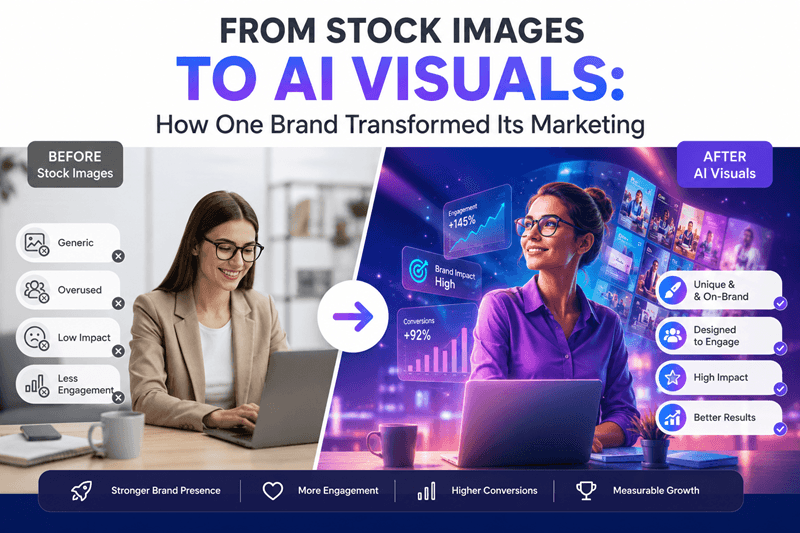
For years, stock photography was the default visual solution for growing brands. It was affordable, easy to license, and fast enough for most campaigns. But the same polished office, smiling employee, laptop, and coffee images began appearing across websites, ads, social posts, and blogs.
Today, brands are moving from generic stock images to AI-generated visuals that are more distinctive, adaptable, and aligned with their brand story. The shift is about building a faster visual content system that supports more campaigns.
This case study explores how a fictional SaaS brand, Northstar, transformed its visual marketing workflow by moving from stock images to AI visuals.
The Starting Point: A Familiar Visual Problem
Northstar had a strong product and active content strategy, but its visual identity was inconsistent. The team relied heavily on stock images for blogs, social posts, landing pages, and emails.
The workflow was simple but slow: search, compare, check licensing, edit, request feedback, and repeat.
A single campaign could require hours of visual sourcing, while the final assets rarely looked connected.
The team realized stock images described the topic, but not the brand. A blog about automation might show someone typing on a laptop. An AI product page might use a standard futuristic illustration. The visuals were relevant, but forgettable.
The Transformation: From Finding Images to Creating Them
Northstar changed one fundamental question:
Instead of asking, “Which image already exists for this topic?” the team began asking, “What visual would best explain this idea?”
That mindset shift opened the door to AI image generation.
Using an AI visual creation workflow, the team could create scenes around specific campaign concepts, product use cases, customer situations, and brand aesthetics. Genimager supports text-to-image generation, AI-powered editing, multiple image models, and reference-image workflows for more controlled creation.
The team created a simple visual system covering brand style, photography direction, realistic people, headline-friendly composition, and a helpful, technology-forward mood.
This became the foundation for scalable AI visual content.
What Changed After the Switch?
1. Content Production Became Faster
With stock photography, the team spent significant time searching for the right image. AI generation changed the process from discovery to creation.
Instead of browsing dozens of images, marketers could generate multiple concepts from one detailed prompt and refine the strongest direction.
That meant faster production for blog graphics, social media creatives, ad concepts, product visuals, and campaign assets.
The biggest benefit was iteration. If a visual did not fit, the team could change the scene, composition, subject, lighting, or style without restarting.
2. Brand Consistency Improved
Stock libraries provide variety, but they do not automatically create a recognizable visual language.
AI visuals allowed Northstar to build repeatable creative patterns. Similar lighting, compositions, environments, and character styles could be used across campaigns.
Assets now felt like parts of one brand rather than disconnected images.
3. Campaign Personalization Became Practical
One major limitation of stock images is that one asset often serves many audiences.
AI visuals made variations easier. Northstar could create different visual concepts for B2B decision-makers, startup founders, remote teams, and enterprise customers.
The copy and offer could remain similar while the visual context changed.
This aligns with a broader 2026 shift toward personalized, human-centric, and data-informed visual content. Genimager's recent guidance also highlights personalization and scalable visual production as important directions for modern marketing.
4. Creative Testing Became Easier
Previously, testing several visual concepts could mean multiple stock searches and design rounds.
With AI image generation, the team could create different visual directions before investing heavily in production:
Concept A: Human-centered workplace
Concept B: Product-focused interface
Concept C: Abstract technology
Concept D: Editorial lifestyle scene
The team could compare performance using click-through rate, engagement, landing-page behavior, and conversions.
Visual design became less about “Which image looks best?” and more about “Which visual helps the audience take action?”
The Results: A More Scalable Visual Engine
After several campaign cycles, Northstar saw three major operational improvements:
Faster asset production
More consistent brand presentation
More creative variations for testing
The biggest transformation was strategic. Visual content stopped being a final design task and became part of campaign planning from the beginning.
Instead of writing an article and searching for an image afterward, the content team planned the visual concept alongside the headline, audience, search intent, and conversion goal.
That is the real opportunity with AI visual content.
It is not about producing more images simply because you can. It is about producing the right visual for the right audience, channel, and moment.
What Brands Can Learn From This Case Study
Stock photography still has a place when real customer photography, authenticity, or licensed editorial imagery is important.
The lesson is that brands now have another option.
AI visuals can help businesses:
Create original marketing imagery
Reduce repetitive design work
Adapt visuals for multiple campaigns
Maintain stronger visual consistency
Test creative concepts faster
Build content at scale
However, quality control remains essential. Audiences are becoming more aware of synthetic content, and overly artificial visuals can reduce trust. The strongest strategy combines AI efficiency with human creative direction, brand guidelines, editing, and careful review. Current industry discussion increasingly emphasizes authenticity and transparency alongside AI adoption.
Conclusion: Build a Visual Brand, Not Just More Images
The journey from stock images to AI visuals is ultimately a transformation in how brands think about content.
Stock libraries answer, “What image can I find?”
AI visual creation asks, “What experience should I create?”
For modern teams, that difference can unlock faster production, stronger consistency, personalization, and more creative testing.
If your team is still spending hours searching for generic visuals, it may be time to rethink the workflow.
Create campaign-ready visuals that match your brand, audience, and message with Genimager. Turn your next content idea into an original visual instead of settling for something everyone has already seen.