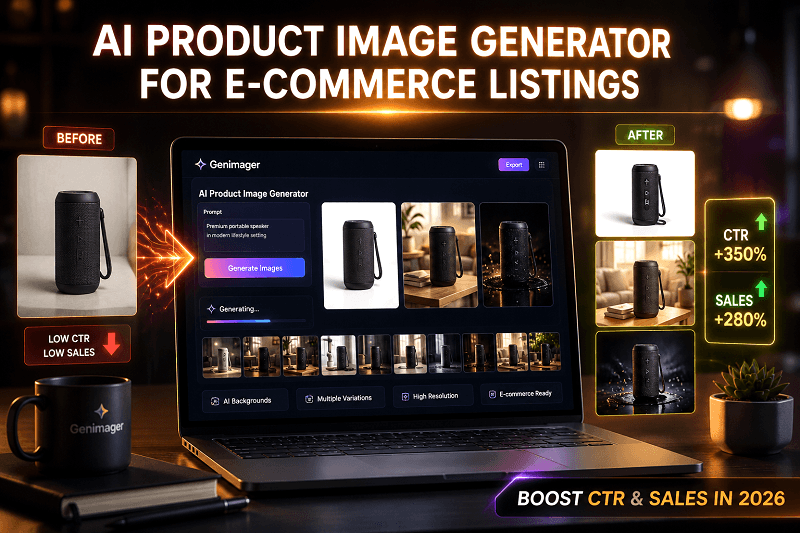
Struggling to get clicks on your e-commerce listings?
Low-quality or generic product images are one of the biggest reasons customers scroll past your products. Traditional product photography is expensive, time-consuming, and difficult to scale, especially if you manage large catalogs or frequently update listings.
Now, e-commerce brands are turning to AI product image generators to create high-quality visuals instantly. With the right approach, you can improve click-through rates (CTR), enhance product appeal, and increase conversions without relying on costly photoshoots.
What is an AI Product Image Generator for E-commerce?
An AI product image generator is a tool that creates product visuals using artificial intelligence based on prompts, inputs, or uploaded product references.
Simple Explanation:
You describe the image.
AI generates a product visual.
You use it in your e-commerce listing.
Key Capabilities:
Generate realistic product backgrounds.
Create lifestyle or studio-style images.
Produce multiple variations instantly.
Customize lighting, angles, and composition.
Tools like Genimager are designed specifically for e-commerce businesses, making it easier to create images optimized for platforms like Amazon and Shopify.
Why E-commerce Listings Need AI Product Images in 2026
E-commerce competition is increasing, and visuals directly influence buying decisions.
Benefits of Using AI for Product Images:
Faster production – Generate images in seconds
Lower costs – No need for photographers or studios
Unlimited variations – Test different styles easily
Consistent branding – Maintain uniform visual identity
Better A/B testing – Optimize for higher CTR
AI helps businesses move faster while improving the quality of their listings.
How AI Product Images Boost CTR & Sales
1. Scroll-Stopping Visuals
AI-generated images can include clean compositions, sharp details, and appealing backgrounds that capture attention instantly.
2. Better Product Context
Lifestyle images show how the product is used in real-world scenarios, helping customers visualize ownership.
3. Faster Creative Testing
You can generate multiple versions of the same product image and test which one performs better.
4. Platform Optimization
Different e-commerce platforms require different image styles:
Amazon prefers clean, white backgrounds.
Shopify allows creative branding.
Ads need bold, eye-catching visuals.
AI allows you to tailor images for each platform quickly.
How to Create E-commerce Product Images Using AI (Step-by-Step)
Follow this simple workflow using tools like Genimager:
Step 1: Upload or Define Your Product
Use an existing product image or describe your product in detail.
Step 2: Write a Clear Prompt
Describe the style, background, lighting, and mood you want.
Step 3: Choose Image Style
Options include:
Studio (white background)
Lifestyle (real-world setting)
Premium (luxury feel)
Step 4: Generate Variations
Create multiple versions to compare performance.
Step 5: Optimize for Platform
Adjust size, format, and style based on where the image will be used.
High-Converting AI Prompts for Ecommerce Listings
Prompts are the foundation of great AI-generated images. Here are examples you can use:
1. Product Listing Prompts
“Minimalist white background product image, soft shadow, high detail, studio lighting”
“Clean ecommerce product photo, centered composition, sharp focus, realistic texture”
2. Lifestyle Prompts
“Product placed in a modern home setting, natural lighting, realistic usage scene”
“Outdoor lifestyle product shot, warm sunlight, soft shadows, natural environment”
3. Premium Product Prompts
“Luxury product photography, dark background, cinematic lighting, high contrast”
“Elegant product image with reflective surface, premium branding feel”
4. Ad Creative Prompts
“Bold product image with vibrant background, high contrast, attention-grabbing composition”
“Dynamic product ad visual, modern design, bright lighting, ecommerce focus”
Tip: Always keep prompts clear and specific for better results.
Use Cases Across E-commerce Platforms
1. Amazon Listings
Focus on white background images.
Highlight product clarity and details.
Follow platform image guidelines.
AI helps create compliant images quickly while maintaining quality.
2. Shopify Stores
Use lifestyle and branded visuals.
Build a consistent store identity.
Improve product presentation
AI-generated images allow store owners to experiment with different visual styles.
3. Ads (Meta & Google)
Use bold and high-contrast visuals.
Highlight product benefits visually.
Test multiple creatives
AI enables faster ad testing, which can improve campaign performance.
AI vs Traditional Product Photography
Factor | AI Image Generation | Traditional Photography |
|---|---|---|
Speed | Instant | Time-consuming |
Scalability | High | Limited |
Flexibility | Very High | Moderate |
Variations | Unlimited | Limited |
AI offers a practical alternative for businesses that need speed and scalability.
Common Mistakes to Avoid
Using overly complex backgrounds
Ignoring platform-specific requirements
Writing vague prompts
Over-editing images
Not testing multiple variations
Avoiding these mistakes ensures better performance and more consistent results.
Future of AI Product Images in E-commerce
AI is becoming a core part of e-commerce operations. In the coming years, businesses will:
Personalize product images for different audiences.
Generate images in real time for ads.
Automate entire product catalogs.
Integrate AI into marketing workflows.
Adopting AI early helps businesses stay competitive and efficient.
Why Choose Genimager for E-commerce Product Images
Genimager is built to help e-commerce businesses create product images quickly and efficiently.
Key Advantages:
Fast image generation
E-commerce-focused outputs
Multiple variations for testing
Easy-to-use workflow
Scalable for growing businesses
Whether you run a small store or manage large catalogs, Genimager simplifies the process of creating high-quality visuals.
Conclusion
Product images directly influence how customers interact with your listings. With AI product image generators, e-commerce businesses can create better visuals faster, test more variations, and improve overall performance.
Instead of relying solely on traditional methods, combining AI with a clear strategy can help increase CTR and drive more sales.
Start generating product images with Genimager.
FAQ
1. What is an AI product image generator?
An AI product image generator is a tool that creates product visuals using artificial intelligence based on prompts or input images.
2. How do AI product images improve e-commerce CTR?
They create more engaging, clear, and visually appealing images that attract attention and encourage users to click.
3. Can AI-generated images be used on Amazon and Shopify?
Yes, if they follow platform-specific guidelines such as background requirements and image quality standards.
4. What makes a good AI product image prompt?
A good prompt is clear, specific, and includes details about lighting, background, composition, and style.
5. Is AI better than traditional product photography?
AI is faster, more scalable, and cost-effective, while traditional photography may still be useful for highly customized shoots.