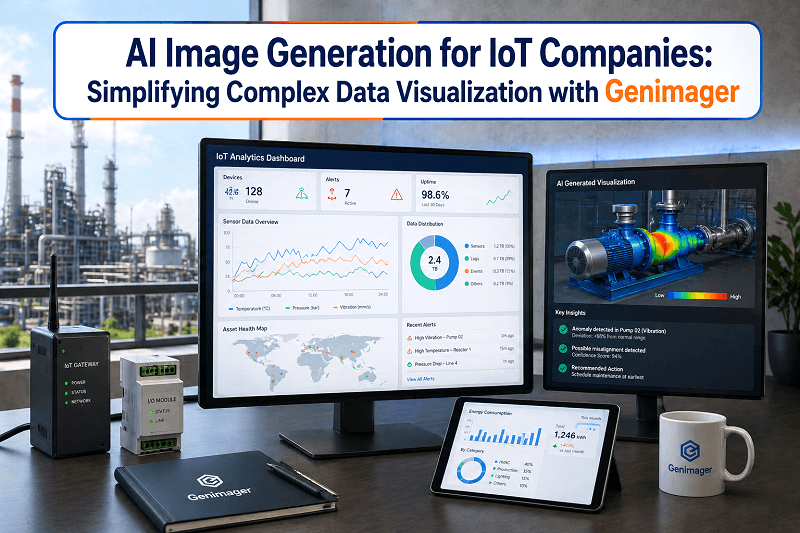
The Internet of Things (IoT) is generating massive volumes of real-time data from connected devices, sensors, machines, and smart systems. However, raw data alone doesn’t drive decisions. The real challenge for IoT companies is transforming complex datasets into clear, engaging, and actionable visuals.
This is where AI image generation is reshaping how IoT businesses communicate insights.
With tools like Genimager, companies can convert dense data streams into high-quality AI-generated visuals, making it easier for stakeholders, engineers, and customers to understand patterns, trends, and performance.
In this guide, you’ll discover how AI image generators simplify complex data visualization for IoT companies, improve communication, and unlock faster decision-making.
What Is AI Image Generation in IoT?
AI image generation refers to the use of artificial intelligence to create visuals, charts, dashboards, and graphical representations from structured or unstructured data.
For IoT companies, this means:
Turning sensor data into dynamic visual dashboards
Generating AI images for reports, presentations, and monitoring tools
Creating real-time visualizations for predictive analytics
Instead of relying solely on manual design or traditional charting tools, AI-powered systems automate the process of delivering accurate, scalable, and visually appealing outputs.
Why IoT Data Visualization Is So Challenging
1. Massive Data Volume
IoT ecosystems generate continuous streams of data, often in real time. Visualizing this data manually becomes inefficient and time-consuming.
2. Complex Data Structures
Data from sensors, devices, and networks is often unstructured or multi-layered, making it difficult to interpret without advanced tools.
3. Real-Time Processing Needs
IoT requires instant insight. Static charts and outdated dashboards fail to deliver timely information.
4. Communication Gap
Technical data is hard to present to non-technical stakeholders, creating barriers in decision-making.
How AI Image Generation Simplifies IoT Data Visualization
1. Automated Visual Creation
AI image generators like Genimager automatically convert raw IoT data into clear, structured visuals, saving time and reducing manual effort.
2. Real-Time Data Visualization
AI tools can generate visuals instantly, enabling:
Live dashboards
Predictive trend graphs
Performance monitoring visuals
This ensures teams always work with up-to-date insights.
3. Enhanced Clarity and Understanding
AI-generated visuals simplify complex datasets by:
Highlighting key metrics
Using intuitive design patterns
Reducing visual clutter
This makes it easier for both technical and non-technical users to interpret data.
4. Custom Visual Outputs
With AI prompts, users can generate:
Network architecture diagrams
Device performance visuals
Heatmaps and analytics charts
This flexibility is especially valuable for IoT companies with diverse use cases.
Key Use Cases of AI-Generated Visuals in IoT
1. Smart Manufacturing
Visualize machine performance, downtime patterns, and predictive maintenance insights using AI-generated dashboards.
2. Smart Cities
Transform traffic, energy, and environmental data into interactive visuals for better urban planning.
3. Healthcare IoT
Convert patient monitoring data into easy-to-read visuals for faster diagnosis and decision-making.
4. Industrial IoT (IIoT)
Create real-time visual reports for operational efficiency, safety monitoring, and system optimization.
Benefits of AI Image Generation for IoT Companies
1. Faster Decision-Making
AI-generated visuals provide instant clarity, helping teams act quickly on insights.
2. Improved Data Communication
Complex IoT data becomes accessible to all stakeholders through simple, visual storytelling.
3. Scalability
AI tools can handle large datasets without compromising performance or quality.
4. Higher Engagement
Well-designed AI images improve presentations, dashboards, and reports—keeping users engaged.
5. Reduced Manual Effort
Automation eliminates the need for repetitive design tasks, allowing teams to focus on strategy.
Why Genimager Is Ideal for IoT Data Visualization
Genimager stands out as a powerful solution for creating AI-generated visuals tailored to IoT needs.
1. Prompt-Based Image Generation
Easily create visuals by describing your data needs.
2. High-Quality Output
Generate professional-grade AI images for dashboards and reports.
3. Customizable Visual Styles
Adapt visuals for technical teams, stakeholders, or marketing use.
4. Scalable for Large Data Sets
Perfect for handling complex IoT environments.
5. User-Friendly Interface
No advanced design skills are required.
With Genimager, IoT companies can move from data overload to visual clarity in seconds.
AI Image Prompts for IoT Data Visualization
Here are some example prompts to generate effective visuals:
“IoT network dashboard with real-time device data, clean UI, blue theme”
“Smart city data visualization with traffic and energy analytics charts”
“Industrial IoT monitoring system with performance metrics and alerts”
“Predictive maintenance dashboard with machine learning insights”
Using the right prompts ensures accurate and visually appealing results.
Best Practices for Using AI Images in IoT
1. Focus on Clarity
Avoid overly complex visuals. Highlight key metrics and insights.
2. Use Consistent Design
Maintain uniform colors, layouts, and styles across dashboards.
3. Optimize for Real-Time Updates
Ensure visuals reflect live data whenever possible.
4. Align With User Needs
Design visuals based on who will use: engineers, executives, or customers.
5. Combine AI with Human Insight
Use AI for speed but refine visuals for accuracy and context.
Future of AI-Generated Visuals in IoT
AI image generation is evolving rapidly. In the future, IoT companies can expect:
Fully automated visual reporting systems
AI-driven predictive visualization models
Integration with AR/VR for immersive data experiences
Smarter, context-aware dashboards
This shift will further enhance how businesses analyze, interpret, and act on IoT data.
Conclusion
IoT companies no longer need to struggle with overwhelming datasets. With AI image generation, complex data can be transformed into clear, engaging, and actionable visuals.
Tools like Genimager make it easy to create high-quality AI images that improve understanding, communication, and decision-making.
Ready to Simplify Your IoT Data Visualization?
Start using Genimager today to turn complex IoT data into powerful visual insights.
Create stunning AI-generated visuals, streamline your workflow, and make smarter decisions faster.
FAQs
1. What is AI image generation in IoT?
AI image generation in IoT is the process of using artificial intelligence to convert complex devices and sensor data into visual formats like dashboards, charts, and graphics for easier understanding.
2. How do AI-generated visuals help IoT companies?
AI-generated visuals simplify complex data, improve communication, and enable faster decision-making by presenting insights in a clear and engaging format.
3. What is the best AI image generator for IoT data visualization?
Tools like Genimager are ideal because they offer customizable, high-quality visuals and prompt-based generation tailored for complex data visualization needs.
4. Can AI image generators handle real-time IoT data?
Yes, advanced AI tools can create visuals based on real-time data, enabling live dashboards and instant insights.