25+ AI Prompt Templates to Create Better Content for SaaS, E-commerce & Creators
AI can help you create faster, but the quality of the output often depends on the quality of the instruction. That is why prompt templates are becoming a practical part of modern marketing workflows. In this guide, you’ll find practical AI prompt templates for SaaS businesses, e-commerce brands, and content creators, plus a simple framework for turning one good prompt into a scalable content workflow.
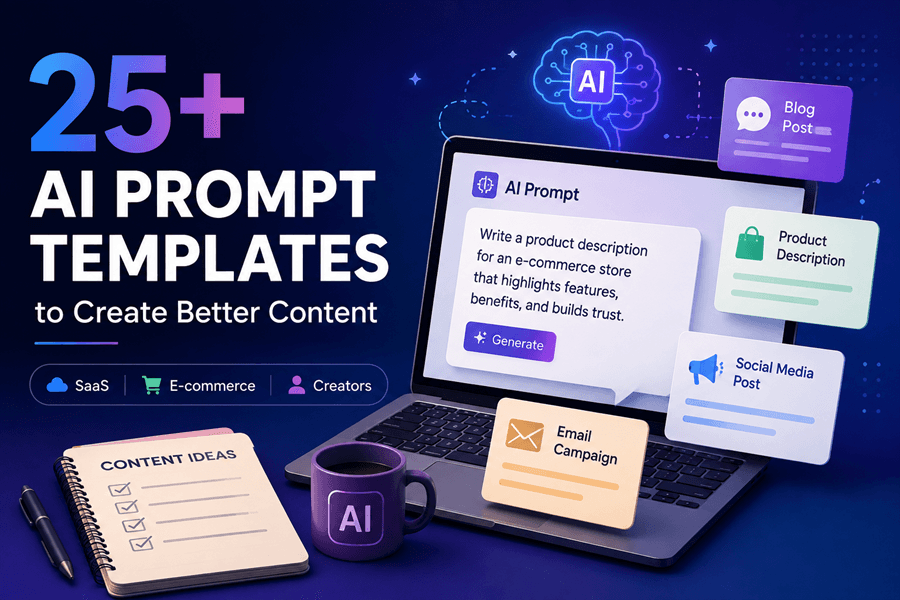
AI can help you create faster, but the quality of the output often depends on the quality of the instruction. That is why prompt templates are becoming a practical part of modern marketing workflows.
Instead of asking AI to “write a post” or “create an ad,” a reusable prompt template gives it the audience, goal, context, tone, format, and conversion objective. In this guide, you’ll find practical AI prompt templates for SaaS businesses, e-commerce brands, and content creators, plus a simple framework for turning one good prompt into a scalable content workflow.
Why Use AI Prompt Templates?
A strong prompt template removes the blank-page problem and creates consistency across campaigns.
Use prompt templates to generate ideas, create SEO briefs, write product and landing-page copy, repurpose content, build social campaigns, improve email workflows, develop creative concepts, and maintain a consistent brand voice.
Use AI for speed, then add human expertise, brand context, fact-checking, and final editing. Google emphasizes helpful, original, people-first content rather than content created mainly to manipulate search rankings.
The Prompt Formula That Works
Before copying the templates below, use this simple structure:
Role + Context + Goal + Audience + Inputs + Format + Constraints + CTA
For example, instead of “Write a product description,” try:
“Act as an e-commerce conversion copywriter. Write a product description for [product] targeting [audience]. Highlight [3 benefits], address [pain point], use the keyword [keyword], keep the copy under [word count] words, and finish with a compelling purchase-focused CTA.”
This gives AI a creative brief instead of a vague command.
AI Prompt Templates for SaaS
1. SEO Blog Brief
“Act as a B2B SaaS SEO strategist. Create a detailed content brief for [topic] targeting [primary keyword]. Include search intent, secondary keywords, suggested H2s and H3s, FAQs, internal-link opportunities, conversion points, and a recommended CTA for [product].”
2. Feature Launch
“Act as a SaaS product marketer. Turn this feature information into launch messaging: [details]. Explain the problem, how the feature works, key benefits, ideal users, use cases, and why it matters. Create versions for a website banner, email, LinkedIn post, and product announcement.”
3. Landing Page Copy
“Write high-converting landing-page copy for [SaaS product]. Target [audience] struggling with [problem]. Include a benefit-led headline, supporting copy, feature-to-benefit sections, objection handling, social-proof prompts, FAQs, and a strong CTA.”
4. Customer Story
“Turn these customer notes into a SaaS case study: [notes]. Structure it as Challenge, Solution, Implementation, Results, and Key Takeaways. Keep claims factual and highlight measurable outcomes where available.”
5. Onboarding Email
“Create a 5-email SaaS onboarding sequence for new users of [product]. Each email should have one goal, a short subject line, useful guidance, one action, and a natural CTA.”
AI Prompt Templates for E-commerce
6. Product Description
“Act as an e-commerce copywriter. Write a persuasive product description for [product]. Use these features [features] and benefits [benefits]. Target [customer]. Naturally include [keyword] and related terms. Make the copy clear, scannable, specific, and conversion-focused.”
7. Product SEO
“Create an SEO package for [product], including an optimized title, meta description, H1, short description, image alt text, FAQs, and keyword variations. Avoid keyword stuffing and keep every element useful to shoppers.”
8. Ad Campaign
“Create 5 ad concepts for [product] targeting [audience]. For each, provide a hook, headline, benefit, and CTA. Use angles such as problem-solution, social proof, urgency, value, and curiosity.”
9. Abandoned Cart
“Write a 3-email abandoned-cart sequence for [product]. Address hesitation without sounding pushy. Include a reminder, product benefits, trust elements, and a final conversion-focused CTA.”
10. Review Insights
“Analyze these customer reviews [paste reviews]. Identify recurring benefits, objections, buying motivations, product strengths, and improvement opportunities. Then turn the insights into marketing messages.”
AI Prompt Templates for Creators
11. YouTube Video
“Create a YouTube video outline about [topic] for [audience]. Start with a strong hook, build curiosity, explain the core ideas with examples, include pattern interrupts, and finish with a memorable takeaway and CTA.”
12. Instagram Content
“Create 10 Instagram post ideas for [niche] around [topic]. Include a hook, content angle, suggested format, caption direction, and audience CTA. Make each idea distinct.”
13. LinkedIn Thought Leadership
“Turn this idea into a LinkedIn post: [idea]. Write in a confident, human voice. Start with a strong first line, share one useful insight, include a practical example, and end with a question that encourages discussion.”
14. Newsletter
“Create a weekly newsletter for [audience] about [topic]. Include one useful insight, one example, three actionable tips, and a soft CTA for [product/service]. Keep the tone conversational and concise.”
15. Content Repurposing
“Repurpose this blog into a LinkedIn post, X thread, Instagram carousel outline, short video script, email newsletter, and five social hooks. Keep the core message consistent while adapting the format and audience behavior for each channel.”
How to Make Your Prompts Better
The best prompt is rarely the first prompt. Improve output with real product information, customer language, examples, brand guidelines, competitor context, and performance data.
Create a prompt library organized by SEO, social media, email, product marketing, research, and creative production. Review high-performing prompts and turn successful instructions into reusable templates.
For search visibility, remember that AI assistance does not replace originality or expertise. Google recommends creating useful, reliable content for people and adding value beyond what is already available.
Conclusion: Turn Prompts into a Content Engine
AI prompt templates can help SaaS teams, e-commerce brands, and creators move from ideas to publishable assets with less friction. But the real advantage comes from building a repeatable system, not collecting hundreds of random prompts.
Start with five templates for your most repetitive marketing tasks. Add your brand voice, audience insights, product details, and conversion goals. Then refine the prompts based on real results.
Ready to create faster and turn ideas into engaging visual content? Explore Genimager and bring your AI-powered content workflow into one smarter creation process. Start creating with Genimager today and turn your next idea into content your audience wants to see.