How Manufacturing Companies Use AI Image Generation to Improve Technical Communication with Gen Imager
Manufacturing organizations operate in environments where clarity is not optional. Production lines, assembly instructions, safety procedures, maintenance workflows and supplier specifications all require precise communication. Gen Imager, a business-focused AI image generation platform, enables manufacturing teams to convert complex technical explanations into clear, contextual visual representations without slowing down operations.
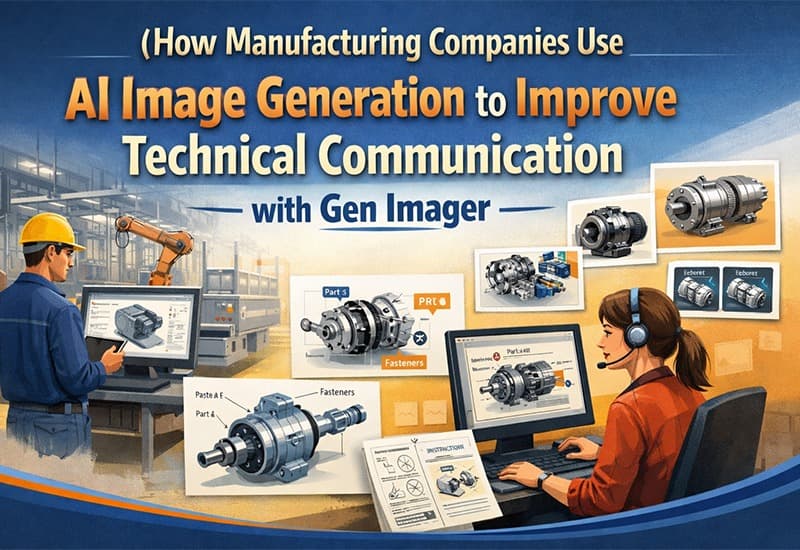
Manufacturing organizations operate in environments where clarity is not optional. Production lines, assembly instructions, safety procedures, maintenance workflows and supplier specifications all require precise communication. Yet, despite operating in highly technical environments, many manufacturers still rely on dense text manuals, static diagrams and outdated visuals that fail to communicate processes effectively.
This is where AI image generation for manufacturing is beginning to reshape documentation and communication workflows. Gen Imager, a business-focused AI image generation platform, enables manufacturing teams to convert complex technical explanations into clear, contextual visual representations without slowing down operations.
As manufacturing becomes more digitized and globally distributed, visual clarity has become a competitive advantage.
The Communication Gap in Modern Manufacturing
Manufacturing teams constantly communicate across multiple layers of stakeholders. Engineers need to explain technical processes to plant operators. Operations managers must document workflows for compliance teams. Suppliers require clarity on specifications. Leadership needs simplified visuals to understand production performance.
Traditional communication methods struggle to bridge these gaps. Technical manuals are often too dense. CAD exports are too complex for non-engineers. Generic stock visuals fail to reflect real production environments. Even creative AI tools like Midjourney or DALL·E prioritize artistic output rather than structured industrial clarity.
This creates friction in onboarding, training and cross-functional collaboration. When processes are misunderstood, production errors increase and safety risks rise.
Clear technical visualization is no longer a luxury. It is a necessity.
How Gen Imager Supports Manufacturing Communication
1. Transforming SOPs into Visual Workflows
Standard operating procedures (SOPs) often sit in lengthy PDF documents that few employees fully read. With Gen Imager, manufacturing teams can generate visual process representations directly from written descriptions. Instead of explaining assembly sequences through paragraphs, teams can create structured, step-by-step visual workflows that improve understanding and retention.
This is especially useful in environments with high employee turnover, multilingual teams or complex machinery operations.
2. Enhancing Safety and Compliance Communication
Safety documentation must be clear, immediate and memorable. Visual communication improves hazard recognition and procedural adherence. Using AI-generated industrial visuals, safety teams can illustrate protective equipment requirements, machine operation sequences and risk zones more effectively than text alone.
Unlike generic AI art tools, Gen Imager focuses on clarity and instructional intent, making outputs more suitable for operational environments.
3. Improving Supplier and Vendor Alignment
Manufacturers work with distributed supplier networks. Miscommunication around specifications or processes leads to delays and quality issues. By generating contextual visuals that represent component placement, process steps or packaging requirements, Gen Imager reduces ambiguity and accelerates alignment.
Visual communication speeds up production readiness.
Why Generic AI Image Tools Are Not Enough for Manufacturing
While tools like Adobe Firefly, Stable Diffusion and Midjourney are popular in creative industries, they are not optimized for structured industrial documentation. Their outputs often prioritize aesthetics over clarity.
Manufacturing environments require visuals that are:
Process-focused
Instructional
Repeatable
Context-aware
Gen Imager is designed for business application rather than artistic experimentation. That distinction matters when visuals impact safety, efficiency and compliance.
The Business Impact of AI Image Generation in Manufacturing
When manufacturers integrate AI image generation into technical documentation workflows, the results extend beyond aesthetics.
Organizations report:
Faster onboarding for plant workers
Reduced training time
Fewer process misunderstandings
Improved safety compliance
Better cross-department collaboration
Visual documentation accelerates operational maturity. As manufacturing continues to adopt Industry 4.0 technologies, tools like Gen Imager act as communication accelerators that support efficiency at scale.
The Future of Visual Manufacturing Communication
Manufacturing is evolving toward automation, smart factories and digital integration. Documentation and communication must evolve as well. AI-powered visualization tools provide a scalable way to maintain clarity as complexity increases.
By adopting AI image generation for technical communication, manufacturers position themselves for safer, faster and more aligned operations.
FAQs
Q1: Can Gen Imager replace engineering CAD drawings?
No. Gen Imager complements CAD by generating explanatory visuals that simplify complex processes for broader audiences.
Q2: Is AI image generation safe for manufacturing documentation?
Yes, when used for explanatory and instructional visuals. It enhances clarity without replacing technical validation.
Q3: How is Gen Imager different from Midjourney in industrial use?
Midjourney focuses on creative art, while Gen Imager prioritizes structured, process-driven visualization for business teams.
Q4: Does this reduce onboarding time in factories?
Yes. Visual SOPs significantly improve comprehension and retention during training.
Q5: Who benefits most from Gen Imager in manufacturing?
Operations managers, safety officers, plant supervisors, supply chain leads and technical documentation teams.