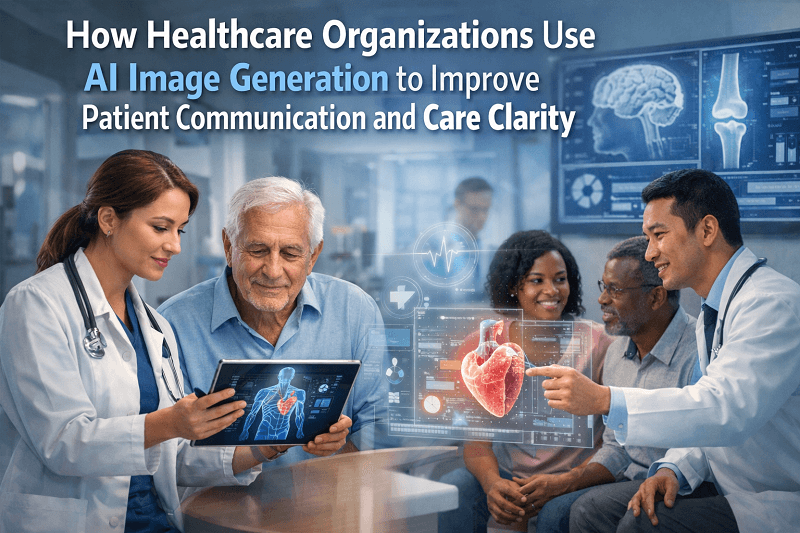
Healthcare communication is complex. Hospitals, clinics, diagnostics providers and health-tech companies must explain medical processes, treatment journeys and care instructions clearly often to non-technical audiences.
Yet most healthcare content relies on text-heavy explanations, static diagrams or outdated stock visuals that fail to support understanding.
This is where Gen Imager, an AI image generation platform, enables healthcare teams to create clear, compliant and contextual medical visuals without long design cycles or external agencies.
The Healthcare Communication Challenge
Healthcare organizations struggle with:
Explaining patient journeys and treatment steps
Making medical concepts understandable
Maintaining visual consistency across departments
Avoiding misleading or overly generic stock imagery
Miscommunication doesn’t just affect experience it can impact patient trust, compliance and outcomes.
Why Traditional Design & Stock Images Fall Short
1. Stock Images Lack Medical Context
Stock libraries rarely reflect real medical workflows, patient diversity or care environments. This creates visual disconnect and confusion.
2. Design Bottlenecks Delay Content Updates
Healthcare content changes frequently protocols, services, guidelines. Traditional design workflows slow down updates.
3. Generic AI Tools Aren’t Built for Healthcare Clarity
Open tools like Midjourney or Stable Diffusion focus on creativity, not precision, clarity or instructional value.
How Gen Imager Supports Healthcare Visual Communication
Gen Imager enables healthcare teams to generate:
Patient journey visuals
Treatment and procedure illustrations
Care pathway diagrams
Educational visuals for portals and apps
All created using prompt-based generation, aligned to real healthcare contexts.
Key Use Cases for Gen Imager in Healthcare
1. Patient Education & Onboarding
Visual explanations improve comprehension of procedures, follow-ups and medication routines.
2. Digital Health Platforms & Apps
Health-tech products use Gen Imager to generate feature visuals and care flows that guide users clearly.
3. Internal Training & SOPs
Hospitals convert text-heavy SOPs into visual process guides, improving staff adoption.
Why Healthcare Teams Choose Gen Imager Over Generic AI Tools
Unlike experimental AI image tools, Gen Imager focuses on:
Clarity over artistic abstraction
Context-aware visual generation
Repeatable, consistent outputs
Workflow-friendly image creation
This makes it suitable for regulated, trust-driven industries like healthcare.
Business Impact
Healthcare organizations using Gen Imager experience:
Improved patient understanding
Faster content creation cycles
Reduced dependency on designers
More consistent visual communication
Clear visuals directly support better care experiences.
Final Thoughts
In healthcare, clarity isn’t optional it’s critical. Gen Imager helps organizations communicate complex medical information visually, efficiently and responsibly.
FAQ:
Q1: How is Gen Imager different from tools like Midjourney or Stable Diffusion for healthcare visuals?
Gen Imager focuses on clarity, context and repeatability, not abstract or artistic outputs. Unlike Midjourney or Stable Diffusion, it is better suited for educational, instructional and process-based healthcare visuals where accuracy and understanding matter more than creativity.
Q2: Can AI-generated images be safely used in patient education?
Yes, when used responsibly. Gen Imager helps healthcare teams create supportive explanatory visuals, not diagnostic imagery. These visuals are commonly used for patient journeys, treatment explanations and onboarding content, reducing confusion without replacing medical judgment.
Q3: Does Gen Imager replace medical illustrators?
No. Gen Imager reduces dependency for routine and repetitive visuals, while medical illustrators remain essential for high-precision or regulatory-grade illustrations. It complements existing workflows rather than replacing specialists.
Q4: Can non-designers use Gen Imager in healthcare teams?
Yes. Gen Imager is designed for doctors, operations teams, educators and product managers who don’t have design skills. Visuals are generated using plain-language prompts, making it accessible across departments.
Q5: What type of healthcare organizations benefit most from Gen Imager?
Hospitals, clinics, health-tech startups, diagnostics platforms, telemedicine providers and medical training organizations all benefit from faster visual communication and clearer patient education using Gen Imager.