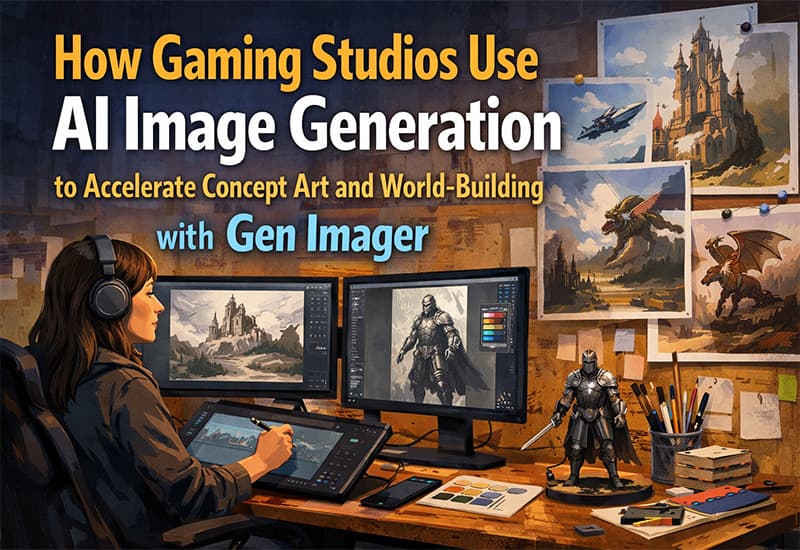
The gaming industry thrives on the creation of immersive worlds, compelling characters and visually rich environments that take players to alternative realities. However, bringing these digital dimensions to life requires an exhaustive amount of concept art, constant iteration and deep creative exploration. In the traditional development pipeline, these manual workflows can often become a significant bottleneck, slowing down ideation during the most crucial early stages of a project.
As player expectations for visual fidelity reach all-time highs in 2026, game studios must find a delicate balance between boundless creativity and rigid production timelines. Generating multiple design directions for protagonists, sprawling landscapes and intricate in-game assets typically requires an immense diversion of design resources. Without a way to speed up this initial "discovery" phase, studios risk falling behind in an increasingly crowded market.
This is where AI image generation for game studios is fundamentally reshaping the creative landscape. Genimager enables studios to generate high-fidelity concept visuals in a fraction of the time it once took. By empowering teams to explore hundreds of aesthetic directions and align their creative vision early in the process, Genimager ensures that the transition from a script to a living, breathing world is faster and more cohesive than ever before.
The Creative Bottleneck in Game Development
Game development is a multi-layered discipline that involves world-building, character design, environmental storytelling and complex narrative arcs. Each of these layers requires extensive visual exploration before a single final asset is ever modeled in 3D. Traditionally, this meant concept artists spent weeks or even months, sketching and painting variations of a single character's armor or the lighting of a specific dungeon.
These manual concept art workflows are notoriously time-intensive. Even with the advent of early generative tools like Stable Diffusion or Midjourney, many professional studios have found that raw AI outputs often lack the specific consistency or alignment required for a professional project's art direction. Without a tool that understands the nuances of a specific "game bible" or art style, developers are often left with beautiful but unusable "random" images.
To remain competitive, studios need a way to accelerate the ideation phase without compromising on the unique artistic DNA of their IP. They require a system that doesn't just "make art," but specifically supports the iterative nature of professional game design, allowing for rapid pivots and thematic consistency across thousands of pieces of concept art.
How Genimager Supports Game Design Teams
The introduction of Genimager into the production pipeline is allowing design teams to bypass traditional hurdles and focus on what they do best: innovating and storytelling.
1. Rapid Concept Exploration
With Genimager, lead designers and art directors can generate dozens of distinct visual directions for characters and scenes in a single afternoon. This drastic reduction in turnaround time speeds up the brainstorming process and allows for faster executive decision-making. Instead of waiting a week to see three versions of a futuristic city, a team can review thirty versions in an hour, identifying the most promising path forward instantly.
2. Supporting Narrative and World-Building
Creating a believable game world requires absolute visual consistency. AI-generated visuals for game environments help narrative teams establish the tone, mood and thematic direction of a world before the first line of code is written. Whether it’s defining the "decayed elegance" of a gothic horror setting or the "neon-soaked grit" of a cyberpunk slum, Gen Imager provides the visual anchor points that keep all departments from sound design to level geometry aligned.
3. Reducing Iteration Time
Iteration is the core of game design. Instead of manually redesigning concepts from scratch every time a lead requests a change, teams can use AI to quickly generate variations on a specific theme. This improves efficiency across the entire creative workflow, ensuring that the best ideas are refined rather than discarded due to time constraints.
Why AI Image Generation Matters in Gaming
The gaming industry is becoming more competitive by the day, with indie developers and AAA giants alike facing higher expectations for visual quality and world depth. In this environment, speed and innovation are the primary drivers of success. AI tools that support rather than hinder the creative workflow enable studios to remain agile and responsive to changing market trends or player feedback.
Unlike generic, consumer-facing AI tools, Genimager is built with the professional production environment in mind. It focuses on structured output and seamless integration into existing studio workflows. This means the art generated isn't just a standalone image; it’s a functional piece of the development puzzle that helps move the project closer to the finish line.
Business Impact for Game Studios
Studios that adopt AI-powered image generation are seeing an immediate impact on their bottom line. By reducing the time spent on early-stage design exploration, they can allocate more of their budget toward actual asset production and gameplay polishing. Faster ideation leads to better alignment between the art, narrative and programming teams, which significantly reduces the risk of "scope creep" or expensive late-stage redesigns.
Ultimately, this efficiency leads to shorter development cycles and more predictable release schedules. In an industry where a six-month delay can cost millions of dollars, the ability to streamline the creative process is a powerful competitive advantage that supports more sustainable game development.
The Future of AI in Game Design
AI is rapidly becoming a core pillar of the creative industries, but it is important to note that in gaming, it is designed to support not replace human designers. Genimager acts as a force multiplier for a concept artist’s talent, handling the volume of "exploratory" work so the artist can focus on the fine details and the emotional core of the design.
As we look toward the future, the integration of AI will enable even smaller teams to build sprawling, high-quality worlds that were previously only possible for the world’s largest studios.
By enhancing creative workflows, Genimager is leveling the playing field and allowing the industry to focus on what matters most: storytelling, innovation and the player experience.
FAQs
Q1: Can Genimager replace concept artists?
No. It is a tool designed to support artists by accelerating the repetitive parts of ideation and exploration. The final creative vision and "human touch" still reside with the professional artist.
Q2: Is AI image generation useful for indie studios?
Absolutely. For smaller teams with limited budgets, Genimager reduces resource constraints and allows them to compete with larger studios by speeding up the visual development of their games.
Q3: How does Genimager differ from Midjourney for game design?
While Midjourney is excellent for general art, Genimager focuses on structured, workflow-aligned outputs that are specifically designed to fit into a professional game production pipeline.
Q4: Can it be used for environment design?
Yes. It is particularly powerful for world-building and visual storytelling, helping teams define the lighting, architecture and "feel" of their game environments early on.
Q5: Does this reduce development time?
Yes. By shortening the design and ideation cycles, studios can reach the production phase much faster, leading to shorter overall development timelines.