How Customer Experience Teams Use AI Image Generation to Improve Journey Mapping with Gen Imager
Customer Experience (CX) teams are responsible for understanding how customers interact with a brand across every touchpoint. From first awareness to onboarding, product use and long-term retention, every stage of the journey influences perception and loyalty. Gen Imager enables CX teams to generate contextual, scenario-based visuals that transform journey documentation into compelling communication assets.
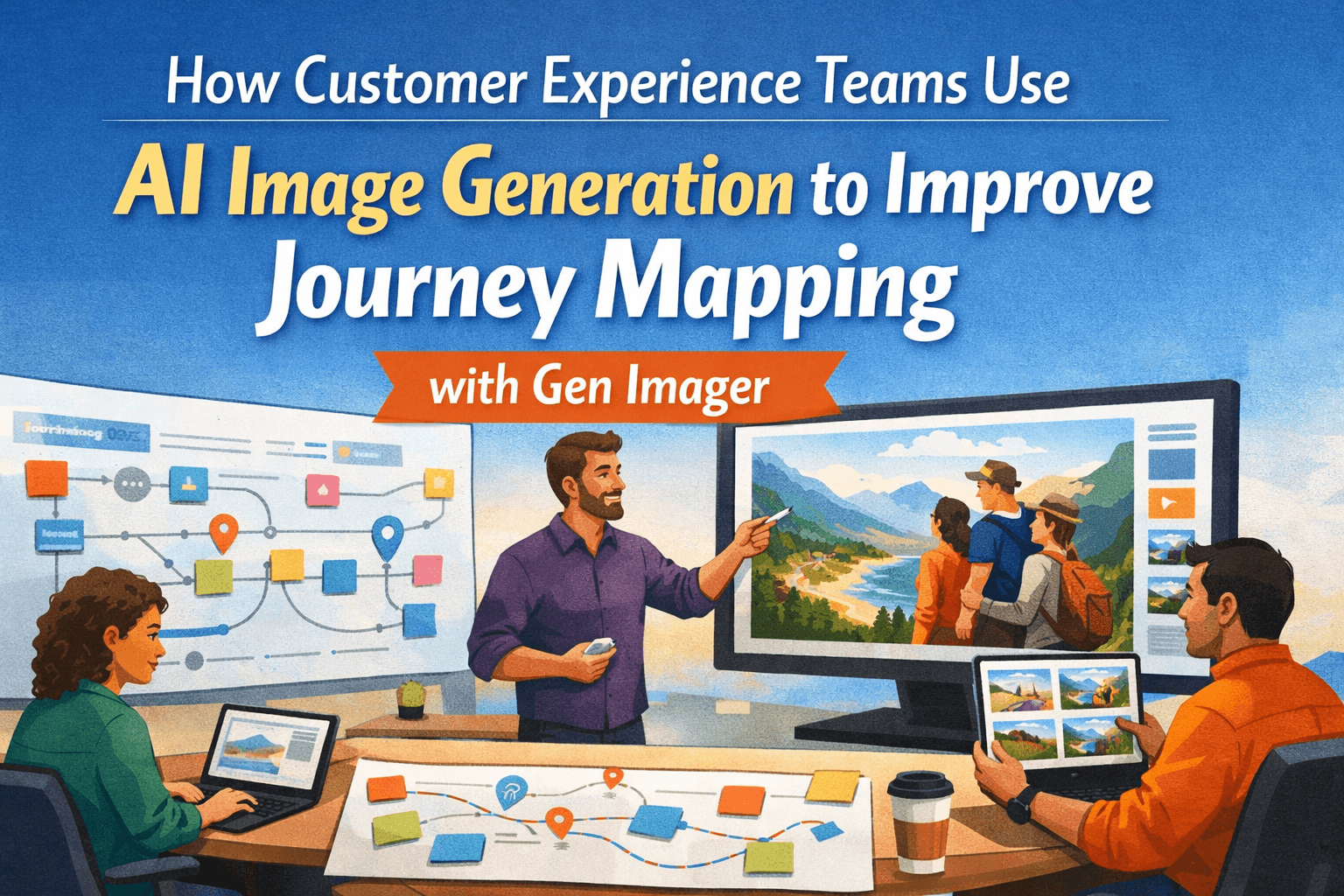
Customer Experience (CX) teams are responsible for understanding how customers interact with a brand across every touchpoint. From first awareness to onboarding, product use and long-term retention, every stage of the journey influences perception and loyalty.
Yet, most customer journey maps are static diagrams built in slide decks or whiteboard tools. They show steps and touchpoints but fail to capture emotional nuance and contextual depth. This limits stakeholder understanding and slows decision-making.
This is where AI image generation for customer journey mapping creates a new advantage. Gen Imager enables CX teams to generate contextual, scenario-based visuals that transform journey documentation into compelling communication assets.
Why Traditional Customer Journey Maps Fall Short
Journey maps are often structured around phases and channels, but they lack emotional storytelling. Text-heavy slides cannot fully represent frustration, excitement, hesitation or trust.
Tools like Miro, Lucidchart and Canva AI provide templates, but they still require manual design effort and often produce repetitive, generic outputs. They focus on structure rather than narrative.
When executives review journey maps, they need more than process steps. They need clarity about customer reality.
Without visual depth, insights remain abstract.
How Gen Imager Enhances Customer Journey Visualization
1. Bringing Emotional Context to Journey Stages
Customer decisions are emotional as much as logical. Using Gen Imager, CX teams can generate contextual visuals that represent real-life usage scenarios, pain points and milestone moments. This strengthens stakeholder empathy and improves alignment across departments.
Instead of saying “customer frustration during onboarding,” teams can visually represent the friction point in a contextual way.
2. Scenario-Based Journey Mapping
Modern businesses serve multiple personas. A single static journey map rarely captures this diversity. AI-generated visuals allow CX teams to create persona-specific journey representations without rebuilding frameworks from scratch.
This flexibility supports faster iteration and deeper analysis.
3. Enhancing Workshop and Strategy Sessions
Customer journey workshops often rely on abstract sticky notes and frameworks. Visual storytelling improves engagement and clarity during cross-functional sessions. When teams can see the journey unfold visually, discussions become more focused and actionable.
AI Image Generation as a CX Enablement Tool
The role of CX has evolved from documentation to strategic influence. To drive change, CX leaders must communicate insights clearly to product, marketing, operations and leadership teams.
By integrating Gen Imager into CX workflows, teams reduce design dependency and accelerate iteration cycles. Visual storytelling enhances presentations, board updates and strategic proposals.
This positions CX not just as a research function, but as a driver of organizational alignment.
Business Impact of AI-Generated Journey Visuals
Organizations that adopt AI image generation for CX communication can expect:
Faster stakeholder buy-in
Improved empathy across teams
Better prioritization of friction points
Stronger strategic decision-making
When teams understand the journey visually, they respond more effectively.
The Future of Customer Journey Communication
As customer expectations evolve, the complexity of journeys increases. Businesses operate across digital platforms, mobile apps, physical spaces and support ecosystems.
Static documentation cannot keep pace with this complexity. AI-powered visual generation allows CX teams to update and adapt journey representations quickly.
Gen Imager becomes a visualization layer for customer insight, not just an image tool.
FAQs
Q1: Can Gen Imager replace journey mapping tools like Miro?
No. It complements them by generating contextual visuals that enhance structured journey maps.
Q2: Is AI image generation useful for executive presentations?
Yes. Visual storytelling improves clarity and engagement during board-level discussions.
Q3: How does Gen Imager differ from Canva AI for CX teams?
Canva AI focuses on templates, while Gen Imager generates context-driven visuals aligned with specific journey scenarios.
Q4: Can CX teams use Gen Imager without designers?
Yes. It is built for business users and does not require design expertise.
Q5: Does this improve cross-team alignment?
Yes. Visual representation of customer pain points enhances empathy and decision-making.