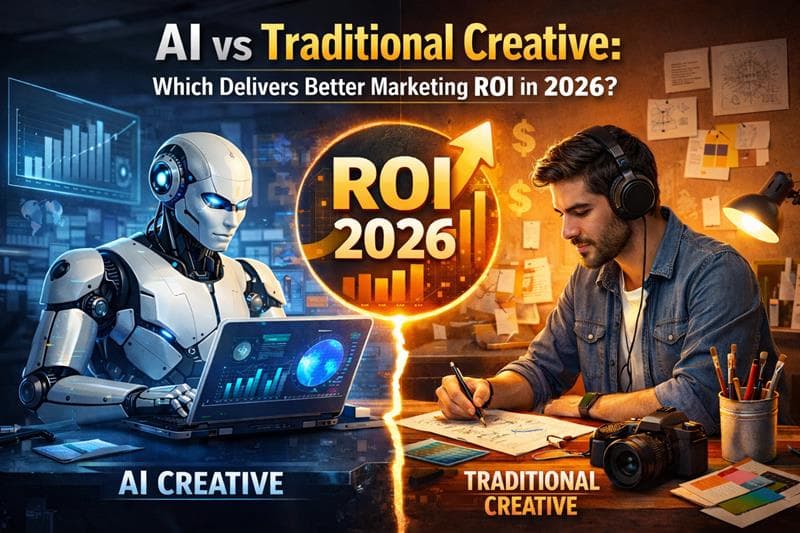
Creative production has always been a balancing act between quality, speed, and cost. For decades, brands relied on traditional creative workflows involving agencies, designers, long timelines, and high budgets. Today, AI-powered creative tools are changing the equation entirely.
The question is no longer whether AI can create visuals. The real question is how AI compares to traditional creative in terms of ROI, speed, and long-term brand impact. Let’s break it down with data, examples, and practical insights for modern businesses.
Why This Comparison Matters for Modern Brands
Marketing teams are under pressure to produce more content across more channels with fewer resources. Social ads, landing pages, email campaigns, and product visuals all demand fresh creative at scale.
Traditional creative struggles to keep up. AI creative platforms like Genimager promise faster execution, lower costs, and measurable performance improvements.
Understanding the real trade-offs helps brands choose the right creative strategy instead of relying on assumptions.
ROI Comparison: AI Creative vs Traditional Creative
1. Traditional Creative ROI
Traditional creative typically includes agency retainers, freelance designers, revisions, and approval cycles. While the output can be high quality, the ROI is often diluted by:
High upfront and recurring costs
Limited creative variations
Slow turnaround reducing campaign agility
A single campaign creative set can cost thousands and still require weeks to launch. Testing multiple variants becomes expensive and risky.
2. AI Creative ROI
AI-driven creative flips the ROI model. Instead of paying per asset or per hour, brands invest in tools that generate unlimited variations on demand.
ROI advantages of AI creative include:
Lower cost per asset
Faster iteration for A/B testing
Better performance optimization through rapid experimentation
Many performance marketers report a 30 to 60 percent reduction in creative production costs when switching to AI-generated visuals, while increasing ad testing velocity.
Verdict: AI creative delivers higher ROI for growth-focused and performance-driven teams.
Speed and Scalability: Where AI Dominates
1. Traditional Creative Speed
Traditional workflows involve multiple stakeholders. Briefing, design, revisions, and approvals can stretch timelines from days to weeks. This slows down campaigns and limits responsiveness to trends or performance data.
Scaling creative output usually means scaling headcount or agency spend.
2. AI Creative Speed
AI creative tools generate visuals in minutes, not days. Teams can instantly adapt creative to different formats, audiences, or channels.
Speed benefits of AI creative:
Instant concept to execution
Real-time creative optimization
Rapid response to trends and performance insights
For example, an ecommerce brand can generate hundreds of product visuals for ads, marketplaces, and social platforms in a single day without additional resources.
Verdict: AI wins decisively on speed and scalability.
Brand Impact: Consistency vs Control
1. Traditional Creative Brand Impact
Traditional creative excels in high-concept brand storytelling. Human designers bring intuition, emotional nuance, and cultural awareness that machines still struggle to replicate fully.
However, consistency can break down when multiple agencies or designers are involved.
2. AI Creative Brand Impact
Modern AI tools are trained to follow brand guidelines precisely. Colors, styles, tone, and layouts can be standardized across all outputs.
Brand benefits of AI creative:
Consistent visual identity at scale
Reduced risk of off-brand assets
Faster localization for global markets
When used correctly, AI does not replace brand strategy. It amplifies it by executing consistently across thousands of assets.
Verdict: Traditional creative leads in conceptual storytelling, while AI leads in brand consistency and execution.
Real-World Use Cases and Examples
Performance marketing teams use AI-generated visuals to test dozens of ad creatives weekly, improving click-through rates and lowering acquisition costs.
SaaS companies generate landing page visuals aligned with messaging experiments without waiting on design queues.
Ecommerce brands create lifestyle images, product variations, and seasonal creatives without expensive photoshoots.
In each case, AI allows faster learning cycles and data-driven creative decisions.
When to Use AI, Traditional Creative, or Both
The smartest brands do not choose sides. They combine strengths.
Use AI creative when:
You need speed and scale
You want to optimize ads through testing
You operate with lean teams or budgets
Use traditional creative when:
You are building a flagship brand campaign
You need deep emotional storytelling
You require highly custom art direction
The winning strategy: Use traditional creative for brand vision and AI creative for execution, testing, and scaling.
Conclusion: The Future of Creative Is Data-Driven and AI-Powered
AI creative is not a trend. It is a competitive advantage. Brands that adopt AI-powered creative workflows gain faster execution, better ROI, and stronger performance insights.
Traditional creative still matters, but it can no longer operate alone in a world that demands speed, personalization, and constant optimization.
If your team wants to produce high-performing visuals without slowing growth or increasing costs, it is time to rethink how creative gets done.
Ready to scale your creative output without scaling your budget?
Start creating high-impact, on-brand visuals in minutes with Genimager.
Explore Genimager today and turn creative speed into growth.