AI Visual Content Trends Marketers Must Use in 2026
Visual content marketing is experiencing its biggest transformation yet. As we navigate through 2026, artificial intelligence has fundamentally changed how brands create, distribute, and optimize their visual assets.
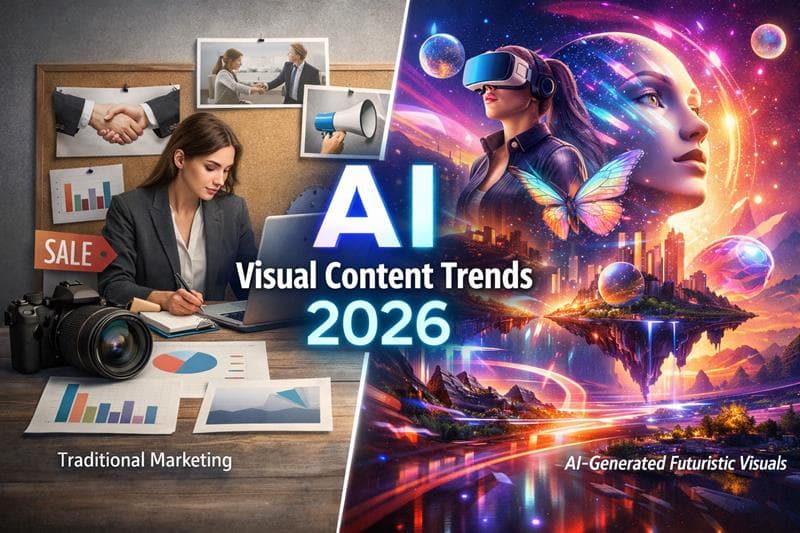
Visual content marketing is experiencing its biggest transformation yet. As we navigate through 2026, artificial intelligence has fundamentally changed how brands create, distribute, and optimize their visual assets. The question is no longer whether to adopt AI for visual content but rather which trends will deliver the highest ROI for your marketing efforts.
The New Visual Language: Why 2026 Demands a Different Approach
Traditional stock photography and generic design templates are losing their effectiveness. Modern consumers can spot inauthentic visuals instantly, and engagement rates prove it. Brands using cutting-edge AI visual content are seeing up to 3x higher engagement compared to those relying on conventional imagery.
The shift isn't just about technology. It reflects deeper changes in consumer psychology. Audiences now crave authenticity, emotional resonance, and visual experiences that feel both fresh and relatable. This is where AI becomes your competitive advantage.
Trend 1: Surreal Aesthetics That Stop the Scroll
Surreal design has exploded across social media platforms, and the numbers back up this trend. Content featuring dreamlike, unexpected visual elements generates 47% more shares than standard product photography.
What makes surreal aesthetics work? They create cognitive dissonance that captures attention in crowded feeds. Think floating objects, impossible perspectives, and reality-bending compositions that maintain brand coherence while standing out.
How to implement surreal visuals:
Blend realistic product shots with fantastical backgrounds
Use unexpected color gradients and lighting effects
Incorporate abstract shapes that complement your brand identity
Test different levels of surrealism to find your sweet spot
Tools like Genimager make creating these sophisticated visuals accessible without requiring advanced design skills or expensive creative teams. The key is maintaining brand consistency while pushing creative boundaries.
Trend 2: Human-Centric Design at Scale
The paradox of AI is that it's enabling more human-centric content than ever before. While AI handles production, marketers can focus on emotional storytelling and authentic connection.
Human-centric visual design prioritizes real emotions, diverse representation, and relatable scenarios. This trend responds directly to consumer fatigue with overly polished, artificial-looking content. Research shows that visuals featuring genuine human moments increase conversion rates by up to 34%.
Key elements of human-centric AI visuals:
Authentic facial expressions and body language
Diverse representation across age, ethnicity, and lifestyle
Real-life contexts that mirror customer experiences
Imperfect, candid moments over staged perfection
The advantage of AI tools is rapid iteration. You can generate dozens of variations showcasing different demographics, emotions, and scenarios, then A/B test to discover what resonates with your specific audience.
Trend 3: Dynamic Personalization Through AI
Static, one-size-fits-all visuals are becoming obsolete. The most successful brands in 2026 are using AI to create personalized visual experiences at scale.
This goes beyond adding a customer's name to an image. Advanced AI visual content adapts based on user behavior, preferences, location, and even time of day. Imagine email campaigns where every subscriber sees product visuals tailored to their browsing history and style preferences.
The technology now exists to make this practical and affordable for businesses of all sizes. Conversion rates for personalized visual content average 2.5x higher than generic alternatives.
Trend 4: Motion and Micro-Interactions
Still images are giving way to subtle animations and micro-interactions. These don't need to be complex videos. Simple movements like gentle floating, color shifts, or parallax effects significantly boost engagement.
Social platforms increasingly prioritize moving content in their algorithms. Posts with motion elements receive 40% more reach than static images. For marketers, this means integrating subtle animation into your visual strategy is no longer optional.
AI tools now generate these motion effects automatically, removing the technical barriers that previously made animation accessible only to specialists.
How to Choose the Right Trends for Your Brand
Not every trend fits every business. Here's how to decide which AI visual content trends deserve your investment:
Audit your current performance. Identify which visual content types currently drive the best results. Use those insights to guide which new trends to test first.
Know your audience intimately. What visual styles resonate with your target demographic? Younger audiences might respond better to surreal aesthetics, while B2B markets might prioritize human-centric authenticity.
Start with small tests. Generate variations using AI tools and run controlled experiments. Let data, not assumptions, guide your strategy.
Measure beyond vanity metrics. Track engagement, click-through rates, and conversion metrics to understand true business impact.
Practical Implementation: Getting Started Today
The barrier to entry for AI visual content has never been lower. Platforms like Genimager provide enterprise-level capabilities without requiring technical expertise or design backgrounds.
Begin by identifying your highest-traffic marketing channels. Create AI-generated visual variations for those channels first. Test surreal elements in social media posts, try human-centric imagery in email campaigns, and experiment with personalized visuals in retargeting ads.
Document what works. Build a visual style guide that captures successful AI-generated elements. This ensures consistency as you scale production.
The brands winning with visual content in 2026 aren't necessarily those with the biggest budgets. They're the ones moving fastest to test, learn, and adapt using AI-powered tools.
Conclusion
The visual content landscape has fundamentally changed. Surreal aesthetics, human-centric design, dynamic personalization, and motion elements aren't just trends but essential components of effective marketing in 2026. The brands that embrace these AI-powered visual strategies now will build significant competitive advantages.
Success doesn't require a complete overhaul overnight. Start with one trend that aligns with your brand and audience. Test, measure, and iterate. The tools exist to make this accessible.
Ready to transform your visual content strategy?
Explore how Genimager can help you create stunning, on-trend AI visuals that drive real business results. Start creating today and join the brands already seeing higher engagement and conversion rates with next-generation visual content.